Introducing Advanced Demand Signals
Who have a (not yet announced) need for your products and services – and why?
Who have a (not yet announced) need for your products and services – and why?
Follow Tenderlake on LinkedIn for concise insights on public-sector tenders and emerging procurement signals.
Every day, Tenderlake helps hundreds of organisations make sure they are informed about relevant public sector contracts and frameworks.
We consistently empower our clients to adopt a more proactive approach by helping them engage with organisations likely to have current or future needs for their products or services—needs that haven't yet led to tenders and may never do so. This gives our clients a significant competitive advantage.
Today we are introducing Advanced Demand Signals.
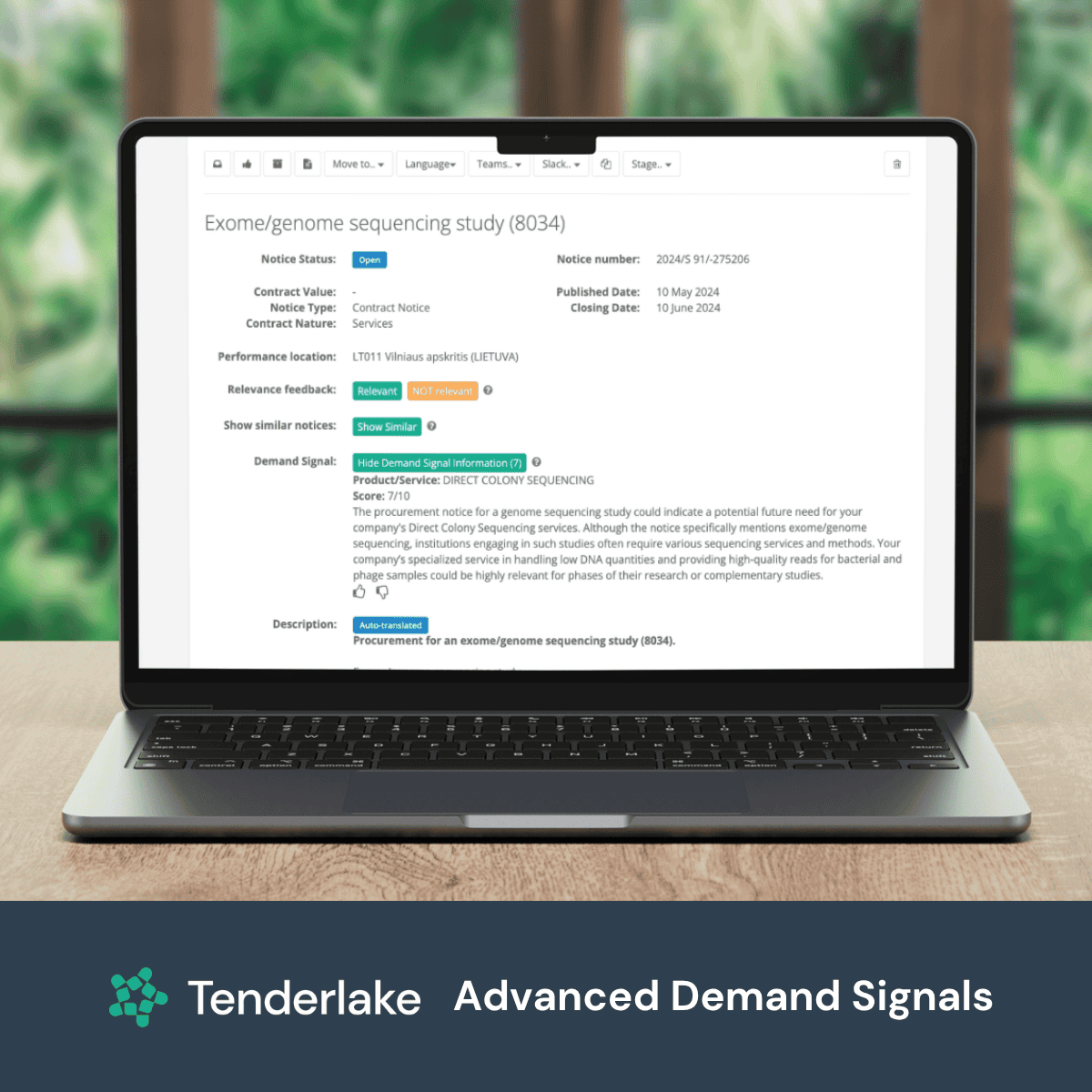
Our clients can now upload descriptions of their individual products and services to Tenderlake. Once done, every procurement notice is analysed to see if it contains any information that makes it likely that the buyer has a current or future need for one of the client's products or services.
Tenderlake will identify this as a demand signal whilst also explaining the rationale and connection to your business.
This not only identifies a likely current or future need, that has not yet been formally expressed but empowers the account executive with the rationale. This helps even the most experienced account executive improve their initial engagement with the prospective client as they can present their products or services in the context of the business.
Let’s take a couple of real examples.
Example 1:
A consultancy offers a service where they help organisations develop a roadmap for the adoption of generative AI.
Tenderlake spots a procurement notice from an organisation seeking to modernise its IT infrastructure and office automation and inviting market input for renewal and sustainability.
Even though the notice does not mention AI at all, Tenderlake correctly identifies the opportunity and generates the following signal:
The procurement notice indicates a desire to modernise IT infrastructure and office automation systems, which suggests openness to integrating new technological solutions, including potentially generative AI. Since your company offers a Generative AI Roadmap to identify and implement AI capabilities, this procurement aligns well with potential future needs for upgrading or automating systems, including AI integration for operational efficiency and competitive advancement.
Example 2:
A company sells advanced laboratory equipment.
Tenderlake spots a procurement notice for geotechnical analysis of a plot of land. The tender notice is not at all related to advanced laboratory equipment.
However, the procurement notice mentions, in a passing mention, that the plan is to build a laboratory on the plot of land. Tenderlake identifies this as a signal of future demand and recommends establishing contact with the relevant people.
Example 3:
A company sells mobile isolation units used to isolate patients inside a hospital ward. A compact box on wheels that folds out to create an isolation “tent” around the patient's bed, complete with managed airflow and air filtering.
Tenderlake spots a procurement notice about the refurbishment of hospital wards. Not relevant for the company at all.
However, buried in the procurement details it is mentioned that the refurbishment needs to take place while the hospital wards are still active. Tenderlake flags this up as a potential opportunity to sell the mobile isolation units and even formulates the pitch to the hospital.
Many more real examples can be found here along with links to the actual procurement notices.
Tenderlake’s Advanced Demand Signals is a game-changer for those seeking to grow their sales to the public sector.
The video below shows how it works.
Take the Next Step
Discover how Tenderlake can transform your public sector sales approach. Visit our website to sign up for a demo and see how Advanced Demand Signals can give you a competitive edge in the market.
The video below shows how to configure Advanced Demand Signals for a service.
Follow Tenderlake on LinkedIn for concise insights on public-sector tenders and emerging procurement signals.