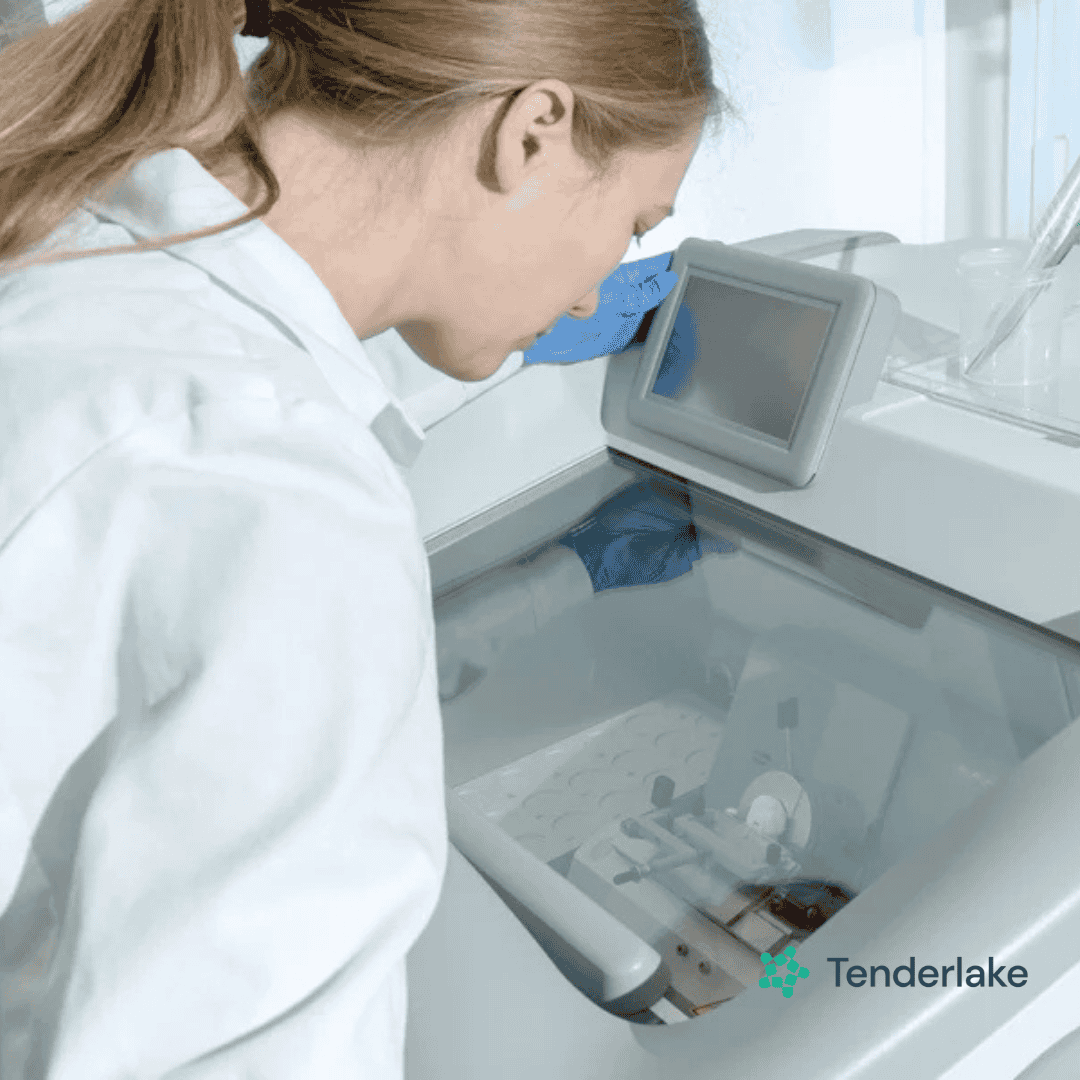
In our latest roundup, we focus on the growing demand for cryostat systems - highly highly specialised equipment that cools samples to extremely low temperatures, often essential for quantum technologies, advanced physics experiments, and new material research. We analysed every procurement of cryostats in EU and UK published during 2024.
"Cryostats are instruments that maintain extremely cold temperatures to study and manipulate materials at the quantum level."
Key Highlights and Trends
- Many Applications of Cryostats: Different institutions require cryostats for quantum matter research, superconducting circuitry, advanced spectroscopy, or cryogenic studies of novel materials.
- Quantum Equipment Surge: Many projects explicitly mention quantum computing or quantum communication infrastructure. This indicates a growing public investment in next-generation research, likely driven by national initiatives and collaboration among universities, government labs, and industry groups.
- Diverse Requirements: Requests vary significantly, from large-diameter dilution refrigerators for millikelvin temperatures to closed-cycle systems with integrated magnets. Some notices even specify vector magnets, which allow magnetic fields to be oriented in multiple directions for deeper analysis of spin-based phenomena.
Compared with the focus on quantum computing hardware earlier in the year, in the second half of the year, attention has widened to include specialised cryostats for optical, spectroscopic, and scanning probe experiments.
Spotlight: Cryostats - Why Are They So Popular?
Cryostats are instruments that maintain extremely cold temperatures to study and manipulate materials at the quantum level. By cooling samples near absolute zero, researchers can observe phenomena that would otherwise remain hidden at room temperature. The sheer variety of notices this month underscores how critical cryostats are across various scientific fields:
- Quantum Circuits and Spintronics – Researchers rely on cryostats to reduce thermal noise, enabling precise control over qubits and spin states.
- Spectroscopy – Low temperatures allow for sharper spectral lines, making it easier to measure subtle energy differences in materials.
- Magneto-Optical Studies – Cryostats fitted with superconducting magnets enable experiments in strong magnetic fields, revealing new properties in condensed matter and photonic structures.
The large wave of new procurements suggests that institutions want to stay at the cutting edge of quantum research, materials science, and advanced spectroscopy.
A Few Standouts This Month
Adiabatic Demagnetisation Refrigerator for X-ray Detection at
CNRS Délégation Paris-Centre
This system is designed to study QED phenomena and will travel between global institutions.
Closed-Loop Dilution Cryostat at
Università di Modena e Reggio Emilia
This notice highlights a cycle-closed system that simplifies operational logistics.
Cryogenic Fusion Magnet Material Tests (market assessment) by
United Kingdom Atomic Energy Authority
Signals an emphasis on large-scale fusion projects that require advanced cryogenic handling.
Sector-by-Sector Overview
The cryostat tenders target different research or industrial sectors:
Unique or Novel Notices
Cryostat for Fusion Magnet Material Tests at the
UK Atomic Energy Authority
underscores the need for cryogenic environments in fusion energy projects, a field that could significantly reshape the global energy landscape.
Ultra-Low Vibration Cryostats for scanning probe microscopy at
TNO
and
Aix Marseille University
enable especially sensitive experiments where even minor vibrations can distort results.
These specialised tenders reflect the sophistication and complexity behind each procurement. They also underscore why staying on top of new notices is crucial: precise technical specs can vary, and project timelines often demand quick responsiveness.
Wrap-Up and Outlook
This month’s notices cement the role of cryostats in pushing the boundaries of both basic and applied science, from advanced quantum circuits to high-precision medical research. Compared to earlier in the year, we see an even stronger focus on compact, helium-free designs and solutions tailored for large-scale collaborative projects.
As public sector buyers expand their research capacities, specialised intelligence makes it far easier to track these evolving requirements. Whether you’re monitoring quantum computing efforts, unique cryogenic spectroscopy setups, or next-generation fusion experiments, having a clear view of emerging notices and their technical details helps you stay prepared.
All signs point to continued growth in cryostat-related procurements as more organisations invest in state-of-the-art cryogenic capabilities. By keeping an eye on these trends, businesses, researchers, and institutions can align their offerings or proposals to match the public sector’s rapidly evolving needs - and continue pushing the frontiers of science and technology.