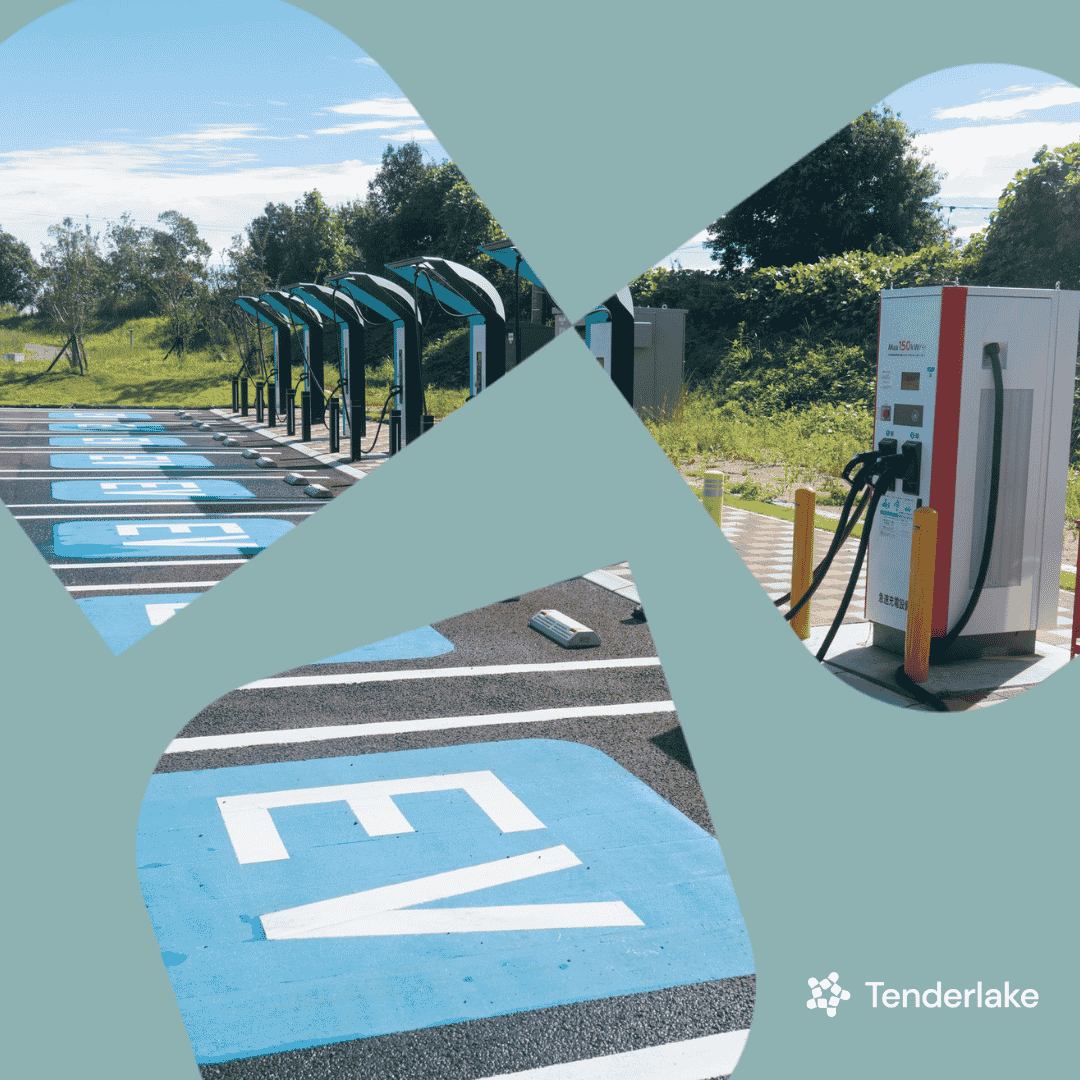
Local authority launches tender for EV charging partner
A local authority is tendering for a partner to deliver and run extensive electric vehicle charging infrastructure, highlighting rising demand in the sector.
A local authority is tendering for a partner to deliver and run extensive electric vehicle charging infrastructure, highlighting rising demand in the sector.
Follow Tenderlake on LinkedIn for concise insights on public-sector tenders and emerging procurement signals.
Published on 19th May 2026, the London Borough of Sutton has issued an electric vehicle charging solutions tender, seeking a partner to implement and manage an extensive charging network across various locations to promote sustainability and cut carbon emissions. The move signals growing confidence in public-private models to deliver the infrastructure needed for widespread EV adoption.
Sutton's notice is brief, but it sets a clear direction. The council wants a partner relationship that covers both delivery and ongoing management of an extensive electric vehicle charging infrastructure. That points towards a multi-site programme rather than isolated installations, and towards a long-term operational role for the chosen supplier.
For suppliers, that combination of implementation and management usually means taking responsibility for design, installation, operation and performance over the life of the assets. It calls for capability across hardware, software, back-office systems and maintenance, and the flexibility to scale as demand for charging grows.
The project is framed around two explicit objectives: promoting sustainability and reducing carbon emissions. That aligns it with a growing wave of public sector procurements that see EV infrastructure not as an isolated transport upgrade, but as part of wider climate strategies.
In February 2026, Wigan Council used a pre-market engagement exercise to seek a long-term partner to supply, install and maintain charging infrastructure in council-owned car parks, with a focus on improving public access. In April 2026, Perth & Kinross Council went to market for a supplier to operate, maintain and expand its charging infrastructure, in collaboration with Angus Council, aiming for a comprehensive and accessible network for residents and visitors. Sutton's emphasis on partnership and management sits squarely within this pattern.
Beyond local government, housing bodies are taking a similar route. In March 2026, Yorkshire Housing began market engagement for a partner to develop and manage its EV charging infrastructure, including existing systems, to support decarbonisation efforts. Days later, Together Housing sought suppliers to help implement communal charging points in residential areas to meet growing demand for EV ownership. Taken together, these notices show how asset-heavy organisations are turning to long-term partnerships rather than piecemeal procurement.
Across multiple authorities, public bodies are moving from isolated pilot schemes towards more integrated networks. In December 2025, Lancaster City Council signalled this shift with a plan for an integrated EV charge point hub at Auction Mart Car Park, combining chargers with solar canopies and battery storage. By February 2026, Tipperary County Council had gone out to tender for a multi-unit charging hub with civil and electrical works at Clonmel's Suirside public carpark, underlining the engineering complexity now expected even at single sites.
Fleet decarbonisation is also reshaping demand. In January 2026, Derry City and Strabane District Council issued a tender for depot-based charging to support new electric vans, with a requirement to integrate with renewable energy sources. In April 2026, Transport for London set out plans to install around 400 charge points to support a transition to a net zero vehicle fleet by 2030, using a market questionnaire to shape its procurement strategy. Sutton's notice does not spell out how far its new infrastructure will support council or commercial fleets, but it lands within this wider move to tie charging into fleet and energy planning.
The Sutton project also sits alongside other low-emission transport initiatives in the area. In December 2025, The Royal Borough of Kingston upon Thames launched a prior information notice for an electric cycle hire scheme, seeking two operators to provide and maintain electric cycles across Kingston and Sutton to promote eco-friendly transportation. With EV charging now on the table, there is scope for a more joined-up approach to cleaner travel options spanning cars, cycles and council fleets.
Large utility and infrastructure owners are following similar paths. In December 2025, Thames Water went to tender for an upgrade of its ageing EV charging infrastructure, calling for a centralised e-mobility platform and ongoing maintenance across selected sites. For suppliers looking at the Sutton opportunity, these examples underline that public-sector buyers increasingly want not just hardware, but integrated systems, data and support services that will stand up over a decade or more.
A recurring theme across recent notices is equitable access, especially for residents without driveways or dedicated parking. In February 2026, Lincolnshire County Council set out plans for county-wide cross pavement charging installations as part of a strategy to provide equitable solutions for residents without off-street parking. In March 2026, Wiltshire Council sought a charge point operator partner to expand public EV charging infrastructure for residents without home charging access, focusing on on-street installations in both urban and rural areas, supported by community engagement and investment.
Similar concerns shape the Cambridgeshire and Peterborough Combined Authority's electric vehicle infrastructure development procurement, which focuses on residential areas with limited off-street parking, and North East Lincolnshire Borough Council's contract notice for on-street charging solutions. In March 2026, Milton Keynes City Council went further by structuring a residential on-street chargers contract as a concession split into two geographic lots, funded by a mix of government and private sector resources.
Funding structures are evolving alongside these access-driven schemes. In May 2026, Lancashire County Council launched an initiative to roll out public charging infrastructure, particularly for residents without off-street parking, using funding from the Local Electric Vehicle Infrastructure fund. Across these projects, the balance between public grants, council capital and private finance is shifting towards mixed models that reward operators for utilisation and long-term performance.
Sutton's contract notice does not yet specify whether its "various locations" will prioritise on-street sites, council car parks or other assets. But the emphasis on extensive coverage and carbon reduction places the project within the same access questions other authorities are now confronting.
How these networks are owned and operated is another key choice for buyers. Some councils are opting for concession models in which a charge point operator funds, installs and runs the infrastructure in return for a share of revenue. Dundee City Council's on-street charging concession, published in February 2026, follows this route, while Milton Keynes explicitly frames its residential on-street programme as a concession contract. North East Lincolnshire, meanwhile, is looking for charge point operators to supply, install, maintain and manage its on-street infrastructure.
Other authorities are keeping ownership in-house while outsourcing delivery and maintenance. South Derbyshire District Council's January 2026 contract notice for 19 charge points at two locations specifies that the chargers will be owned by the council and maintained by the supplier. The Highlands and Islands Transport Partnership's maintenance and supply contract similarly underlines the importance of clear arrangements for upkeep and local contractor engagement.
The market is also widening beyond traditional council estates. In May 2026, Places for People and Anchor Hanover Group launched market engagement for delivery, management and maintenance of EV infrastructure across social housing and care facilities. Buckinghamshire Council's prior information notice for on-street chargepoints and Haringey Council's exploration of operator options for its charging network further demonstrate the demand for partners who can manage mixed portfolios of sites with varying usage patterns.
Some buyers are also experimenting with additional revenue streams. In May 2026, Tower Hamlets issued a contract notice seeking a single supplier to install, maintain and operate 23 EV charge points featuring digital advertising screens at key locations, through its EV chargers with advertising screens procurement. Models like this show one way contracts can balance user tariffs with other income sources.
Against this backdrop, Sutton's requirement for a partner to both implement and manage an extensive network leaves several questions open: who will fund the assets, how revenue will be shared and what service levels will be required over time. Those details are not yet visible from the short contract notice, but they will be central to how attractive the opportunity looks to suppliers and to how much new infrastructure the borough can secure.
The Sutton procurement is still in its early stages, and the current notice offers only a headline view of the project. When fuller documentation emerges, suppliers and residents alike will be watching for clarity on:
Whatever the eventual shape of the contract, the notice published on 19th May 2026 confirms that electric vehicle charging is now a core infrastructure concern for local authorities, not a peripheral experiment. With multiple councils, housing providers, utilities and transport bodies going to market for partners, the competitive landscape for EV infrastructure suppliers is already becoming busier and more demanding.
Tenderlake Monitor reads every public sector notice published across the UK, the EU and the EEA, in the language it was published in, and tells you which ones match what your company sells and why. It works from a plain description of your business, not from keywords or CPV codes.
Follow Tenderlake on LinkedIn for concise insights on public-sector tenders and emerging procurement signals.