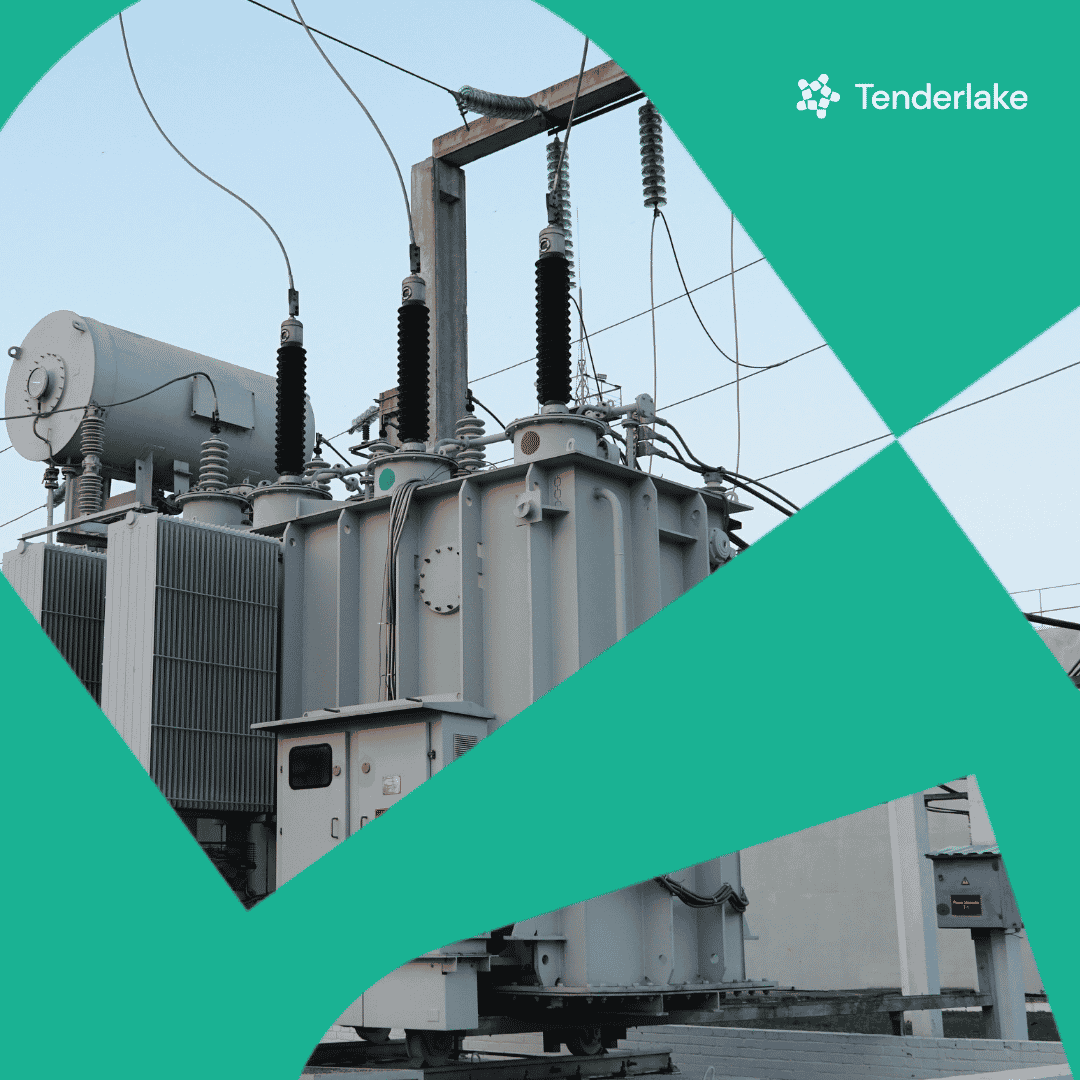
Utility launches tender for 160 MVA transformer for BESS
A major power utility seeks design, manufacture and installation of a high‑capacity transformer to support battery storage and future grid flexibility.
A major power utility seeks design, manufacture and installation of a high‑capacity transformer to support battery storage and future grid flexibility.
Follow Tenderlake on LinkedIn for concise insights on public-sector tenders and emerging procurement signals.
Slovenské elektrárne, a.s. is going to market for a 160 MVA block transformer to anchor a large battery storage system, underlining how high‑capacity transformers are moving to the centre of battery energy storage system (BESS) design and grid stability planning.
Published on 18th May 2026, the contract notice from Slovenské elektrárne, a.s. covers the block transformer delivery for a major storage project. The scope runs from initial design through to on‑site installation.
The buyer wants a 160 MVA oil‑insulated, three‑phase transformer that will support a battery storage system and allow for future expansion. The wording makes clear that this is not a like‑for‑like replacement, but part of building out new capacity with headroom for growth.
The successful contractor will be responsible for:
Bundling all these stages into one contract places technical and delivery risk squarely on the supplier side. It also gives the utility a single point of accountability for an asset that will sit between a large battery installation and the wider grid.
The explicit reference to “future expansion capabilities” points to a storage strategy that anticipates growing needs for flexibility. The transformer will have to cope not only with the initial BESS configuration, but also with additional storage or changing operating modes over time.
The Slovenské elektrárne, a.s. notice sits alongside a cluster of recent procurements where transformers and BESS are tightly coupled.
In May 2026, ENEA Nowa Energia sp. z o.o. launched a contract for Supplies of Transformers for BESS. That tender covers direct delivery of high‑voltage/medium‑voltage transformers for multiple storage projects, including transport, placement, technical support and testing. The buyer has split the contract into three parts, with a total of five transformers, and is open to partial offers.
Also in May 2026, Liechtensteinische Kraftwerke issued a prior information notice for a Battery Storage System Procurement at Balzers. The utility is preparing to buy a BESS of at least 25 MW / 50 MWh, with the building permit already secured and the future contractor expected to deliver and commission the system.
Thermal generator owners are taking similar steps. In May 2026, TERMOELEKTRARNA BRESTANICA D.O.O. advertised a contract for Battery Energy Storage System Construction, covering design, delivery, installation, testing and grid connection of a complete BESS, plus documentation.
Earlier in March 2026, Verdo issued an EU tender for a Battery Energy Storage System for Verdo at its production site in Denmark. That project aims to provide backup power, strengthen grid support and optimise energy costs, underlining the multi‑purpose role BESS now play in power system operations.
Beyond the power sector, other operators are exploring storage to support complex facilities and networks. In December 2025, Centre National d'Etudes Spatiales launched a consultation on Battery Energy Storage System Integration at the Guiana Space Centre, seeking to pin down technical and functional requirements for a new system.
In April 2026, rail infrastructure manager Infrabel sa published a market consultation titled Market Consultation for Energy Storage. It is seeking information on a BESS and bidirectional converter for a 3 kV DC railway network, signalling interest in storage to stabilise traction power and manage energy more flexibly.
Taken together, these projects show buyers treating transformers, converters and control systems as integral parts of BESS design, not add‑ons. The Slovenské elektrárne, a.s. transformer tender fits that pattern: a grid‑critical component specified from the outset to match the storage asset’s role.
The main contract notice also aligns with a strong run of recent procurements for large power transformers and associated switchgear.
In May 2026, Enefit OÜ went to market for Power Transformer Production and Delivery, covering a new 120 MVA unit for the Baltic Power Plant in Narva, with transportation included.
In March 2026, Landsvirkjun sought an 82 MVA generator step‑up unit through its Generator Step-up Transformer tender. The scope includes design, manufacture, testing, transportation and supervision of installation for a new generating unit.
Municipal and regional grid operators are following the same pattern. Stadtwerke Steinburg GmbH is tendering for Transformers for a New Substation, including delivery and assembly of 110/20 kV units rated 50–63 MVA. TEN Thüringer Energienetze GmbH & Co. KG has gone to market for a Transformer Switchgear Project, covering planning, delivery, assembly and commissioning of transformer switchgear and integration of the medium‑voltage system at an existing 110 kV substation.
Enercity AG is taking a slightly different route with its May 2026 tender for Phase-Shifting Transformers for Substations. That project seeks two 150 MVA phase‑shifting transformers to enable controllable power exchange and reactive power compensation, underlining how advanced transformer technologies are being used to manage flows in meshed networks.
Further down the voltage levels, e-netz Südhessen AG has advertised a multi‑quarter contract for Distribution Transformers Supply, seeking oil‑insulated, encapsulated, hermetic‑design units split into two lots to bolster security of supply, with the intention to award to two different suppliers.
Stadtwerke Karlsruhe Netzservice GmbH has issued a framework agreement for Oil Transformers, explicitly tying the supply to VDE eco‑design rules and European directives.
Taken together with tenders from RheinEnergie AG, Enexis Groep, Öresundskraft AB, ESE‑Energia Oy and others, the picture is one of sustained demand for transformers across the voltage range. Many of these procurements, like the Slovenské elektrárne, a.s. notice, bundle design, testing, logistics and installation, pushing manufacturers to offer more complete project capability.
Even where tenders are not labelled as BESS projects, they often anticipate higher electrification, on‑site generation or backup needs.
Bäderland Hamburg GmbH, for example, has published a contract notice in January 2026 for Medium Voltage System Development. The project involves building a new customer‑owned facility with switchgear, an outgoing field and a transformer sized for around 1400 kVA, with maximum capacity of 1600 kVA, and explicit provisions for renewable energy management and uninterruptible power supply support.
Utilities such as Versorgungsbetriebe Bordesholm GmbH are going further by tendering for Battery Storage System Construction, combining delivery, installation and commissioning of battery inverters and transformers for a storage system at a solar facility, with optional maintenance.
Other buyers, including Städtische Werke AG and Lippeverband, are procuring turnkey battery storage systems complete with power electronics, low‑voltage connections and integration with central control technology. These projects show a convergence between substation upgrades, behind‑the‑meter resilience and large‑scale storage, all of which rely on well‑specified transformers.
The Slovenské elektrárne, a.s. block transformer delivery will be one to watch as the associated storage project takes shape. The technical specification and delivery model it chooses could set a useful reference for other large BESS‑linked transformers in the region.
For suppliers, the notice reinforces a clear message from recent tenders: buyers expect integrated offerings that cover design, testing, logistics and installation, and that anticipate future expansion of storage and flexible demand. How manufacturers respond, and how quickly these projects move from tender to operation, will help define the next phase of the BESS and transformer market.
Tenderlake Monitor reads every public sector notice published across the UK, the EU and the EEA, in the language it was published in, and tells you which ones match what your company sells and why. It works from a plain description of your business, not from keywords or CPV codes.
Follow Tenderlake on LinkedIn for concise insights on public-sector tenders and emerging procurement signals.