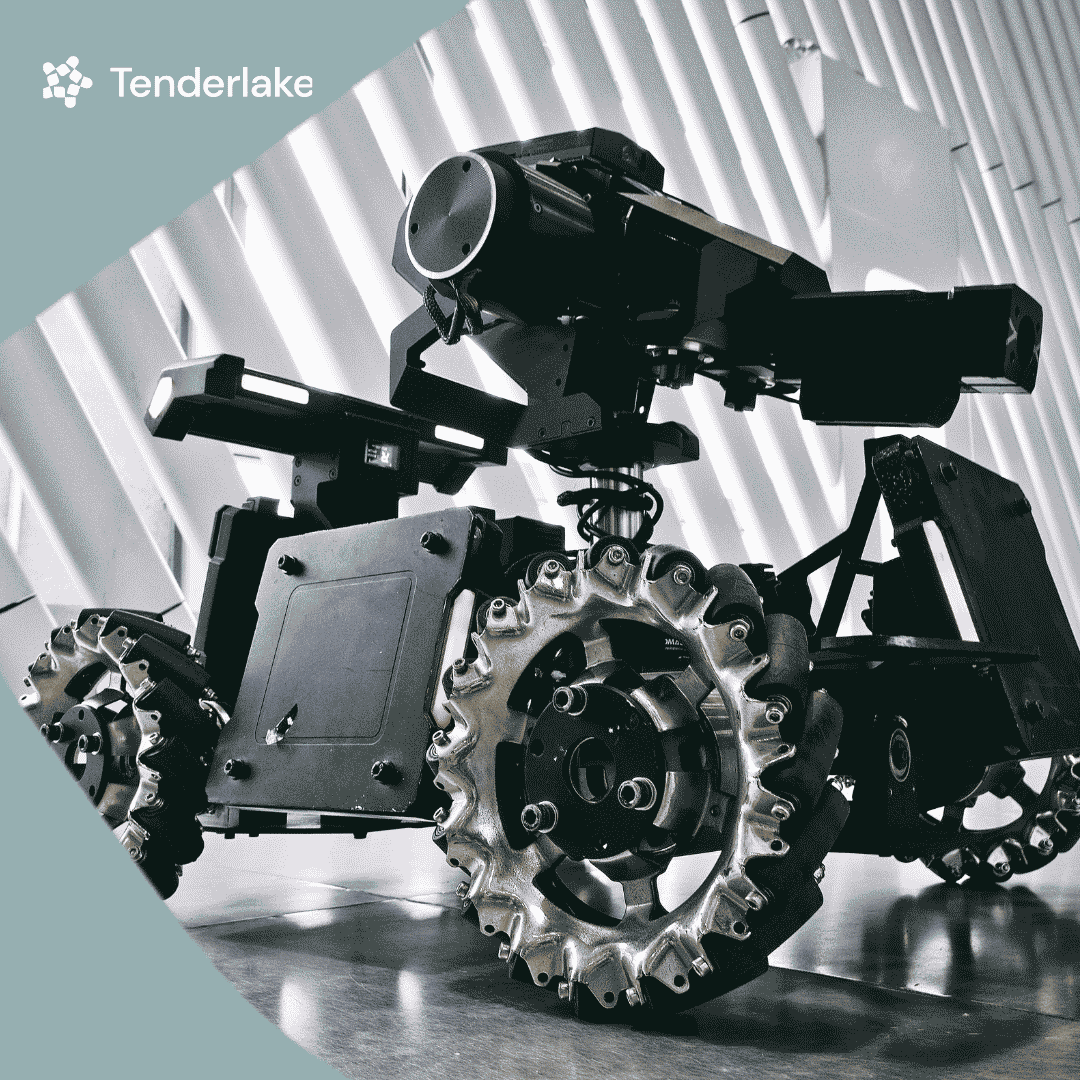
Defence authority launches tender for unmanned amphibious combat vehicle
Tender seeks supply of an unmanned amphibious combat vehicle, highlighting rising demand for complex unmanned platforms across defence buyers.
Tender seeks supply of an unmanned amphibious combat vehicle, highlighting rising demand for complex unmanned platforms across defence buyers.
Follow Tenderlake on LinkedIn for concise insights on public-sector tenders and emerging procurement signals.
A naval logistics directorate has issued a contract notice for the Supply of Unmanned Combat Vehicle, seeking the supply of an Unmanned Amphibious Combat Vehicle (UXV). The brief publicly available description points to a further move towards unmanned platforms in combat roles, adding an amphibious capability to a 2026 procurement landscape already featuring unmanned surface, underwater and aerial systems.
In a contract notice published on 22nd October 2026, the Dirección de Gestión Económica de la Jefatura de Apoyo Logístico de la Armada set out a straightforward requirement: “Supply of Unmanned Amphibious Combat Vehicle (UXV) is required.” The contracting authority, part of the armed service’s logistics support structure, is looking not for consultancy or research but for the delivery of a defined unmanned combat platform.
The wording leaves many questions open. The summary does not state how many vehicles are sought, what performance characteristics are required, or how the UXV should interface with existing systems. Even so, specifying an “amphibious combat” role signals interest in a vehicle able to operate in more than one environment and to contribute directly to combat tasks, rather than focusing solely on surveillance, training or logistics.
By defining the project around an Unmanned Amphibious Combat Vehicle, the logistics directorate is moving beyond the more familiar categories of unmanned surface or underwater vehicles. The requirement introduces an unmanned capability that bridges land and water operations, rather than operating only on the sea surface or below it.
Recent notices across defence and research show how quickly unmanned platforms are spreading into different domains. In August 2026, the Intendente de Rota issued a contract notice for the Supply of Unmanned Surface Vehicle, seeking a USV ASUW for maritime operations. In July 2026, the Wojskowa Akademia Techniczna im. Jarosława Dąbrowskiego published its Unmanned Underwater Vehicle Supply tender, covering an unmanned underwater vehicle for structure assessment, sample collection and underwater reconnaissance for the WIG Research Laboratory. By September 2026, Universität Rostock was procuring an Unmanned Water Vehicle under UVgO/NA regulations.
These projects are not limited to acquiring hardware alone. In August 2026, the DEPT OF DEFENSE advertised UUV Operator and Maintainer Training, focused on training services for operating and maintaining unmanned underwater vehicles. In July 2026, MAEE-Direction de la Défense launched a Micro UAS Supply for Army to meet the operational requirements of the Luxembourg Army, while Jelgavas valstspilsētas pašvaldība announced a prior information notice for the Purchase of Unmanned Aerial Vehicles. Taken together, these notices describe a landscape in which armed forces, universities and municipalities are building families of unmanned systems, from micro air assets to research-grade underwater vehicles.
Against that background, the amphibious UXV sought by the naval logistics directorate extends unmanned capability into a new niche, adding a combat-focused system that connects shore-based and waterborne operations.
Alongside the rise of unmanned systems, 2026 has brought a steady flow of tenders for manned vehicles in defence and civil protection. In April 2026, Valsts aizsardzības loģistikas un iepirkumu centrs published the Light Cargo Vehicle Supply notice, covering military-type light cargo universal vehicles (4x4) and light cargo universal vehicles (4x4) with cargo boxes. In October 2026, Ministério da Defesa Nacional - Marinha went to market with the Supply of Tactical Vehicles, seeking ultra-light tactical vehicles, while in June 2026 the Irish Defence Forces advertised the Supply of All Terrain Vehicles for small all terrain utility vehicles.
Civil and emergency services are following a similar path. In April 2026, Município da Moita sought an Urban Fire Fighting Vehicle Acquisition, and in May 2026 JAVNI ZAVOD ZDRAVSTVENI DOM PTUJ issued a notice for the Supply of Rescue Vehicle of Type C. September 2026 then saw OBČINA LENART tender for a Firefighting Vehicle Supply equipped with an aerial platform, alongside the SERVICE D'INCENDIE ET DE SECOURS DU HAUT-RHIN’s call for a Supply of Multi-Purpose Vehicle including chassis and equipment.
Other authorities are reshaping logistics and support fleets with multi-role vehicles. Landeshauptstadt Saarbrücken has issued a Universal Module Carrier Vehicle Procurement notice for a carrier and interchangeable module for logistics and transport, while Commune Les Belleville is running a Vehicle Supply and Delivery competition covering 4x4 vans, utility vehicles, light vehicles, a 19-ton truck for winter maintenance and articulated wheeled loaders. Polismyndigheten, meanwhile, is procuring Vehicles for Coast Guard Operations to support underwater work.
The common thread across these procurements is a focus on mobility and role-specific equipment. The amphibious UXV tender sits at the intersection of these trends: it is a vehicle requirement, but it brings autonomy and remote operation into areas that have traditionally been served by crewed platforms.
Some buyers are already bundling unmanned assets with wider equipment packages. In May 2026, Comando Brigata Paracadutisti “Folgore” published a contract notice titled Supply of Army Engineer Materials. The order combines unmanned aerial vehicles with ballistic shields, tactical protective masks and rugged tablets, all aimed at enhancing the combat capacity of army engineer units. Unmanned systems here are one component in a broader effort to refresh protection and digital equipment.
Elsewhere, training and support are treated as separate capabilities in their own right, as shown by the DEPT OF DEFENSE’s UUV Operator and Maintainer Training notice from August 2026. For industry, these examples underline that a single vehicle contract can be only one step in a wider programme of tenders covering training, maintenance, payloads and associated equipment. Observers will be watching to see whether the amphibious UXV acquisition generates similar follow-on activity over time.
The contract notice for the Supply of Unmanned Combat Vehicle is terse, and the detailed technical and commercial conditions sit behind the headline summary. Yet even that brief line shows that the Dirección de Gestión Económica de la Jefatura de Apoyo Logístico de la Armada is adding an unmanned amphibious combat vehicle into its planning at the same time as defence, research and civil authorities across Europe and beyond are expanding their unmanned and specialist vehicle fleets.
As full documentation and any subsequent clarifications emerge, potential suppliers and analysts will focus on how the contracting authority defines the UXV’s operating environments, its integration with existing naval and land systems, and the balance between off-the-shelf and bespoke elements. Set alongside the growing set of unmanned surface, underwater and aerial projects notified in 2026, this amphibious UXV procurement will be a useful indicator of how far naval forces are prepared to push unmanned combat capabilities into mixed land–water environments.
Tenderlake Monitor reads every public sector notice published across the UK, the EU and the EEA, in the language it was published in, and tells you which ones match what your company sells and why. It works from a plain description of your business, not from keywords or CPV codes.
Follow Tenderlake on LinkedIn for concise insights on public-sector tenders and emerging procurement signals.