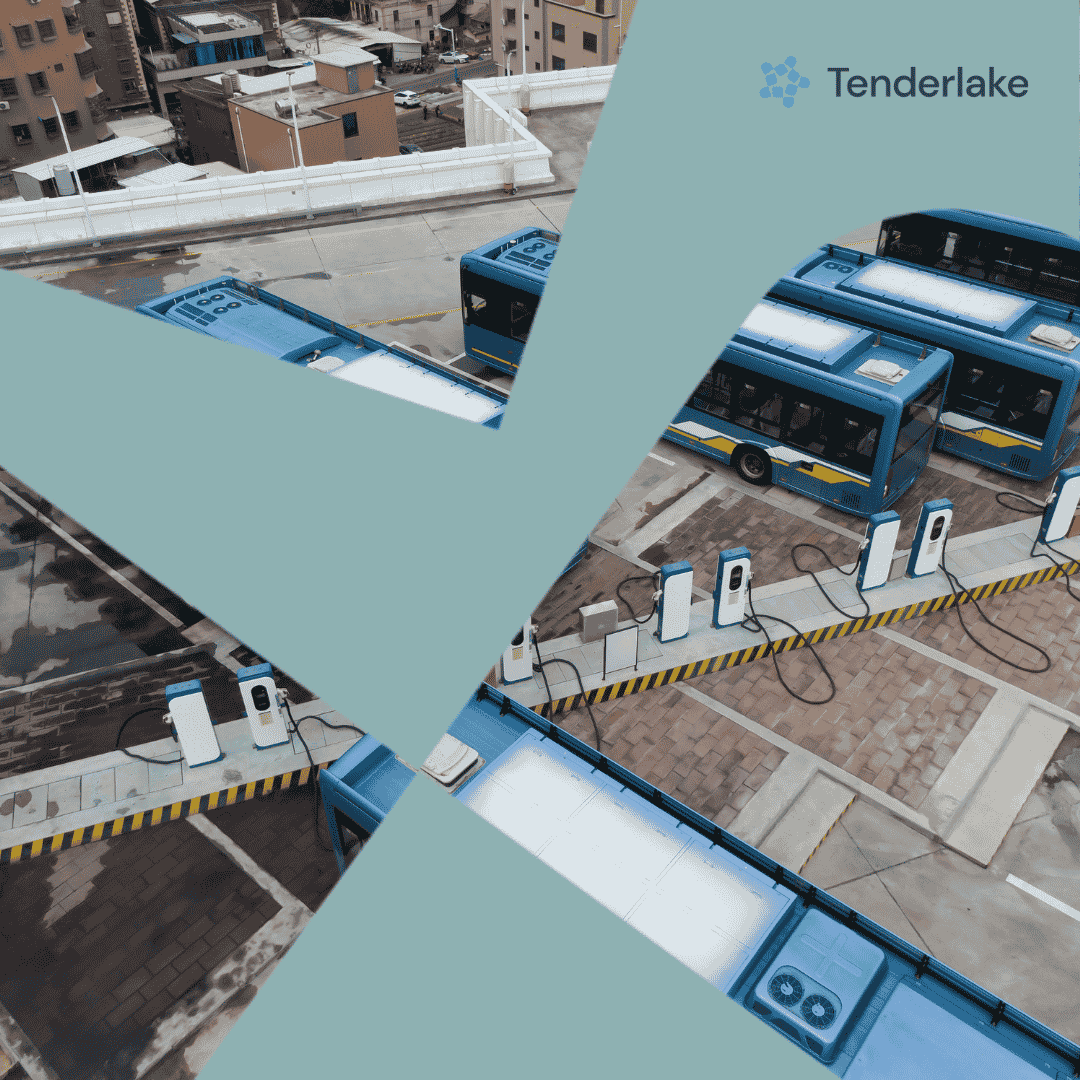
Transport authority launches tender for depot smartcharging system
Tender seeks supplier to deliver and commission smart depot charging for an electric bus fleet, illustrating growing demand for large-scale EV infrastructure.
Tender seeks supplier to deliver and commission smart depot charging for an electric bus fleet, illustrating growing demand for large-scale EV infrastructure.
Follow Tenderlake on LinkedIn for concise insights on public-sector tenders and emerging procurement signals.
Saint‑Étienne Métropole is procuring a smartcharging system to supply, install and commission electric bus charging infrastructure at two depots. The project underpins its move towards an electric bus fleet and sits within a busy European market for large‑scale depot electrification, where authorities are bundling hardware, software and grid capacity into single contracts.
On 8th June 2026, Saint‑Étienne Métropole published a contract notice for a smartcharging solution for electric buses. The authority is seeking a supplier to provide, install and commission the charging infrastructure needed for its transition to an electric bus fleet, with multiple charging points to be deployed across two depots.
The emphasis is on a complete depot system rather than isolated chargers. By combining provision, installation and commissioning in one contract, the buyer is asking the market to take responsibility for integrating the equipment into working depots. In December 2025, Valpi Bus launched an Electric Buses and Charging Stations tender combining standard electric buses with charging stations, management systems and grid connections, while Expressdiagram issued a near‑identical Electric Buses and Charging Stations contract.
Other operators have chosen an infrastructure‑first path closer to Saint‑Étienne Métropole’s. In January 2026, EW Bus GmbH issued a Charging Infrastructure for Buses notice to plan and construct scalable depot charging, including transformer technology, for a regional bus fleet. The Municipal Transport Company of Esslingen is procuring power supply and charging infrastructure for battery trolleybuses at two locations under its February 2026 Charging Infrastructure for Trolleybuses contract, while Bad Homburg’s March 2026 Charging Infrastructure for Electric Buses tender covers chargers for 15 battery‑electric buses at two sites and a backend system for monitoring and maintenance.
The Saint‑Étienne Métropole notice labels the project a smartcharging solution, signalling that the scope goes beyond supplying plugs and cables. Recent bus projects show how operators are defining that term. SM Artois Mobilités’ March 2026 contract for Supervision of Electric Bus Charging covers the design, implementation and commissioning of a smart charging system for depots in Houdain, Grenay and Hénin‑Beaumont, with a focus on intelligent scheduling, energy cost optimisation, monitoring and data processing.
In May 2026, FS Omnibus GmbH & Co. KG went to market for Charging Infrastructure for eBuses, combining manufacturing, delivery and commissioning of charging infrastructure with maintenance services, optional expansion and an intelligent charging and load management system. Earlier, in February 2026, Hagener Straßenbahn AG’s Charging Infrastructure for Electric Buses tender required depot chargers, additional power‑supply capacity and charging points along bus routes, all to be integrated so that systems are functional and compliant with safety standards.
Scale is a recurring theme. Enotrac AG’s May 2026 E‑Mobility Charging Infrastructure project at the Schwäbis depot in Thun is designed to support a complete switch to an electric bus fleet by 2036, including 10 charging rectifiers and 48 charging points. Verkehrsbetriebe St. Gallen’s June 2026 Charging Infrastructure Procurement similarly seeks depot chargers, mobile charging stations and project services such as planning, installation and maintenance. Together, these contracts show that smartcharging is now understood as a mix of power engineering, control software and long‑term operational support.
Behind each depot charging project sits a substantial package of electrical and civil works. In March 2026, the Société des Transports Intercommunaux de Bruxelles published its Bus Depot Electrification Project for the Petite‑Île depot, covering new high‑ and low‑voltage systems, charging structures, fire safety measures and outdoor surface development, while keeping depot operations running during construction. In May 2026, Dresdner Verkehrsbetriebe AG’s second‑stage Charging Infrastructure for Electric Buses contract bundled the procurement of charging equipment with installation, planning services and integration of technical components to electrify specific bus lines.
A similar depth of preparation appears in Central European projects. The transport operator in Olomouc is building charging stations for electric buses at four locations under its April 2026 Construction of Charging Stations tender, which includes project documentation and compliance with required permissions, funded by a grant from the Integrated Regional Operational Program. In Kobylnica, Miejski Zakład Komunikacji is procuring six dual‑position slow‑charging stations, with an option for five more, plus the necessary electrical and telecommunication infrastructure through its April 2026 Electric Bus Charging Stations contract. February 2026 saw the Zlín – Otrokovice Transport Company seek eight bus charging stations, system management equipment, warranty service and operator training in its Electric Vehicle Charging Stations notice.
Compared with these detailed descriptions, the summary of Saint‑Étienne Métropole’s contract focuses tightly on providing, installing and commissioning the necessary infrastructure and multiple charging points at two depots. Other authorities are explicit about additional elements such as civil works, power‑supply reinforcement, long‑term maintenance and training. For suppliers reading the Saint‑Étienne Métropole notice, the question will be how far such wider tasks are wrapped into the smartcharging solution, and how much is being handled through separate arrangements.
While Saint‑Étienne Métropole’s current contract is centred on bus depots, many buyers are now linking depot projects to wider EV charging networks. In January 2026, Bordeaux Métropole launched an Electric Vehicle Infrastructure Services tender to install, maintain and supervise EV charging infrastructure, educational radar systems and taxi stands across 28 municipalities. In May 2026, Intercommunale IDEA’s Electric Charging Stations Project for the Heart of Hainaut region set out a programme to supply, install, commission, operate and maintain 64 double charging stations and up to 28 single stations. The Syndicat Départemental d’Energie de Seine‑Maritime is going further under its April 2026 Public Charging Infrastructure Project, seeking a public service delegation to implement, finance and operate a charging network, including existing and new stations.
Other public bodies are integrating workplace and on‑street charging. France Travail’s June 2026 Electric Charging Stations tender covers the supply, installation, maintenance and supervision of charging infrastructure across France and Corsica, including management of existing stations and monetisation of charging for its staff. Wavre’s March 2026 Electric Vehicle Charging Infrastructure contract takes the form of a concession for installing, replacing, operating and maintaining local charging stations, while the municipality of Dej is procuring 10 smart‑city charging stations under its March 2026 Electric Vehicle Charging Stations project.
Alongside these general EV networks, a stream of bus‑specific procurements is pairing vehicles with charging. SEMOP TEM’s February 2026 Electric Bi‑articulated Buses Procurement includes 28 electric bi‑articulated buses and a fast charging system for the Transports of the Eurometropolis of Metz. Municipal Transport Ruse’s May 2026 Electric Bus and Equipment Procurement combines eight new electric buses with slow charging stations, training and warranty maintenance, while Trolleybus Transport Pleven’s May 2026 Electric Buses and Charging Stations covers buses, charging stations, electronic systems and staff training. Against this backdrop, Saint‑Étienne Métropole’s depot‑centred smartcharging tender underlines how charging infrastructure is becoming a distinct procurement stream in its own right, and how decisions taken at depot level will shape the pace and practicality of bus fleet electrification.
Market watchers will focus on how the smartcharging system is specified in detail, and whether later procurements bring long‑term operation and links to wider EV networks into the same scope.
Tenderlake Monitor reads every public sector notice published across the UK, the EU and the EEA, in the language it was published in, and tells you which ones match what your company sells and why. It works from a plain description of your business, not from keywords or CPV codes.
Follow Tenderlake on LinkedIn for concise insights on public-sector tenders and emerging procurement signals.