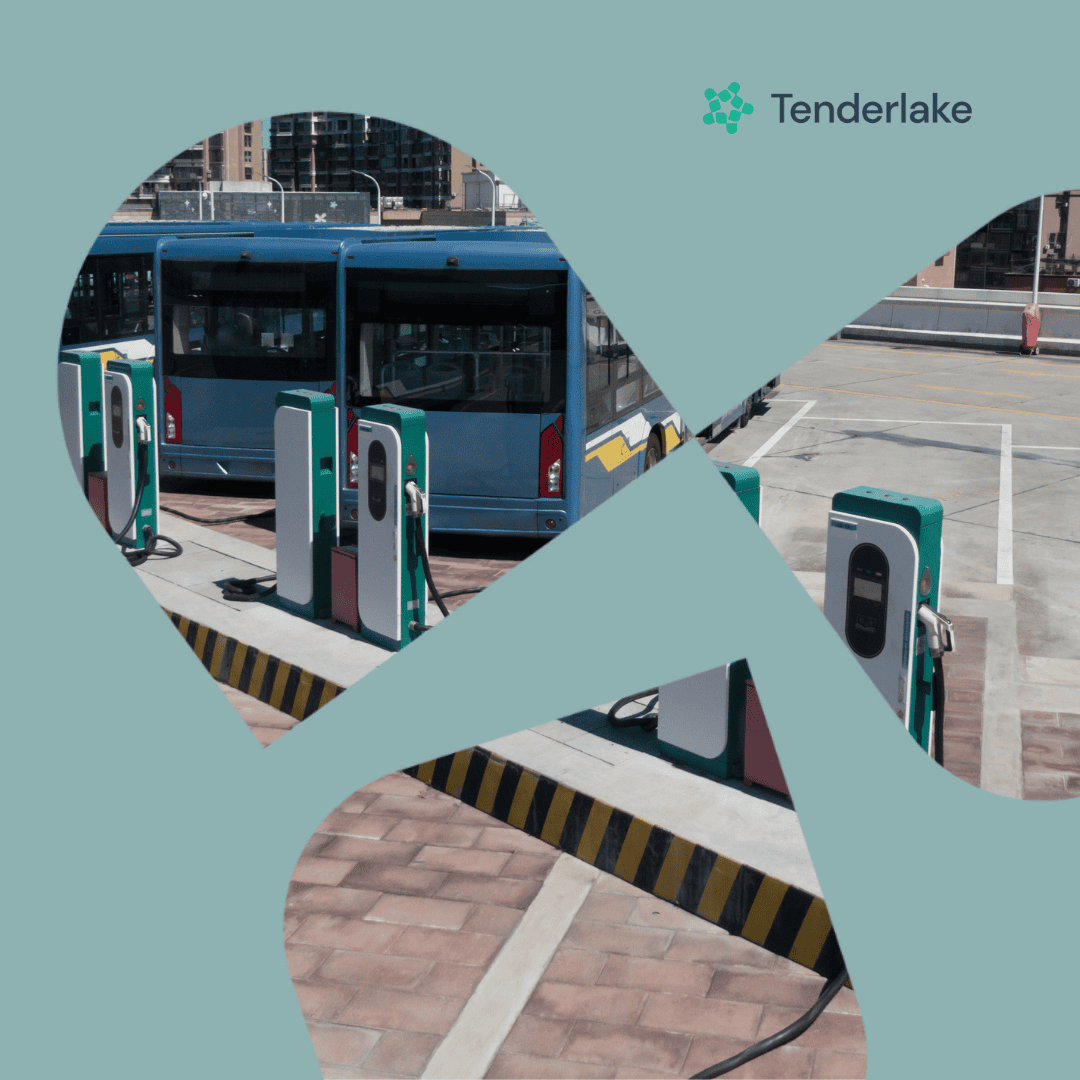
Public sector gears up for major high-power electric bus charging rollout
A new framework for designing, installing and maintaining high‑power bus chargers shows how public bodies are turning climate goals into grid‑connected projects.
A new framework for designing, installing and maintaining high‑power bus chargers shows how public bodies are turning climate goals into grid‑connected projects.
Follow Tenderlake on LinkedIn for concise insights on public-sector tenders and emerging procurement signals.
Published on 27th November 2025, the National Transport Authority’s new framework for high‑power charging infrastructure for battery‑electric buses aims to secure design, supply, installation and maintenance services, together with upgrades to the electrical distribution networks that feed depots. The move shifts attention from headline bus orders to the more complex task of building and looking after the power systems that make large‑scale zero‑emission bus operations possible.
Under the Electric Bus Charging Infrastructure Supply framework, the National Transport Authority is seeking partners who can deliver a complete package of high‑power charging solutions for battery‑electric buses. That runs from front‑end tasks such as system design through to hardware supply, on‑site installation and ongoing maintenance.
The notice also brings the distribution network into scope by covering upgrades to associated electrical distribution systems. That signals an expectation that bus depots and charging locations will often need new or reinforced connections, substations and cabling rather than simple additions to existing power capacity.
Other public transport bodies are tackling vehicles and charging infrastructure in a single procurement. Miasto Białystok’s July 2025 contract for the supply of 60 new electric city buses and 15 charging stations combines vehicles, chargers, staff training and warranties. In September 2025, Società Unica Abruzzese di Trasporto TUA S.p.A. followed a similar path with a framework for the supply of 40 full‑electric buses along with technical services for the design, construction and maintenance of charging infrastructure at its depot in Pescara.
Dresdner Verkehrsbetriebe AG intends, through its October 2025 notice to procure up to 45 electric buses with the necessary charging infrastructure, to grow fleet and power systems together, while France’s framework for the acquisition of new standard and articulated electric buses covers vehicles equipped for both slow and fast charging. By comparison, the National Transport Authority’s framework isolates the infrastructure piece, pointing towards a reusable platform to support multiple bus procurements over time. The scale, locations and phasing of those projects are not yet set out in the notice.
Moving from pilot schemes to full depots of battery‑electric buses turns a charging project into a substantial piece of electrical and civil engineering. High‑power systems must be designed around depot layouts, duty cycles and safety requirements, and they often depend on strengthening local distribution networks. The National Transport Authority’s decision to bundle design, installation, maintenance and network upgrades into one framework reflects that reality.
Elsewhere in Europe, bus operators are taking a similar whole‑project view. In August 2025, PROMET d.o.o. launched a turnkey contract for the preparation of project‑technical documentation and construction of charging infrastructure for electric city buses, placing responsibility for planning and build with a single supplier. KViP – Kreisverkehrsgesellschaft in Pinneberg mbH is procuring, via its July 2025 notice for charging infrastructure for battery‑electric buses, a tightly defined package of 27 DC charging points with depot boxes, electrical connections and system management components.
Swiss operator Transports publics fribourgeois Trafic, in a June 2025 tender for electric bus charging equipment, links supply and maintenance to the decarbonisation of its fleet and to technical, environmental and social standards. PaderSprinter GmbH’s November 2025 procurement for charging infrastructure in Paderborn folds planning, delivery, installation and maintenance into one contract, while CPI eMobility’s September 2025 framework for the supply and installation of AC and DC charging stations requires connection to the client’s back‑end systems and a five‑year warranty. Across these notices, long‑term performance, monitoring and service provision are becoming as important as the chargers themselves.
The National Transport Authority is far from alone in using frameworks to organise large‑scale charging roll‑outs. In August 2025, Leicestershire County Council, trading as ESPO, put in place a national framework for vehicle charging infrastructure solutions, giving public bodies a route to procure the supply and installation of charging points and related services for ultra‑low and zero‑emission vehicles. Germany’s defence procurement office is seeking, through its August 2025 charging infrastructure framework agreement, a full‑service provider to plan, construct, operate and supply electricity for charging infrastructure across seven regional lots for the Bundeswehr.
Cities and housing providers are also standardising how they buy charging services. Prague’s municipal technology company is procuring, via June 2025 framework agreements for a Framework Agreement for Charging Stations, the project and engineering capacity needed to construct standalone chargers across the city. Copenhagen’s June 2025 tender for the installation, operation and maintenance of publicly accessible charging stations on municipal roads emphasises compliance with national legislation and a competitive balance between price and quality. Partenord Habitat’s September 2025 Electric Vehicle Charging Stations Agreement adds long‑term operation and maintenance and includes options for renewal.
Some buyers are pursuing tighter standardisation. PRO EMV, s.r.o. is setting up a single‑supplier framework for the supply of electric vehicle charging stations in three power variants, while Trondheim kommune’s June 2025 plan for charging stations for chargeable motor vehicles and a back system combines various charger types at multiple locations with connection of existing equipment and a central system for monitoring and support. Together with the National Transport Authority’s notice, these projects point to a European market where public‑sector buyers increasingly want integrated networks of chargers rather than isolated points.
Alongside hardware and construction, several contracting authorities are starting to tackle the electricity supply side through dedicated frameworks. Munícipia, Empresa de Cartografia e Sistemas de Informação, S. A. is procuring, in November 2025, a framework for the supply of electricity to public charging stations for electric mobility. Romania’s Infrastructure and Services Directorate in Bistrița is seeking, via a September 2025 framework agreement for low‑voltage electricity supply, to cover multiple consumption points over 42 months, with subsequent contracts reflecting variable demand. The government of Catalonia has bundled fuels and power together in a September 2025 framework for the supply of fuel and electricity that includes electricity for public vehicle charging across several provinces. Although the National Transport Authority’s framework focuses on infrastructure and distribution networks rather than electricity as a commodity, its scope reflects the same recognition: bus charging is now an energy‑system issue as much as a transport one.
The move towards large, long‑term electrical frameworks extends beyond road transport. Iarnród Éireann – Irish Rail is looking for a single supplier under its June 2025 framework for a design and build electrification contractor for the DART+ programme, supporting an expanded electrified rail network and fleet in the Greater Dublin Area. The University of Edinburgh’s June 2025 Electrical Works and Associated Services framework agreement adopts a similar model for its estate, dividing work into lots and evaluating bids on both technical and commercial criteria.
Vehicle orders are increasingly electric‑first as well. A Czech interior ministry framework published in October 2025 covers the ongoing supply of electric passenger cars for the police and special units, while central purchasing bodies such as France’s Centrale d'Achat du Transport Public are aggregating demand for electric buses that can use both slow and fast charging. Against that backdrop, the National Transport Authority’s emphasis on charging infrastructure and distribution networks fills in a critical piece of the transition for heavy‑duty bus fleets.
Questions remain about how the new framework will operate in practice. The notice does not specify budgets, the number or location of depots, or whether any on‑route charging is in scope. Dublin Bus / Bus Átha Cliath’s July 2025 civils framework for electric bus charging infrastructure, which separates civil engineering works into distinct lots and uses a mix of single‑party and mini‑competition contracts, offers one model of how charging projects can be sequenced. How the National Transport Authority chooses to coordinate civil works, electrical upgrades and vehicle deliveries will determine how quickly new electric bus corridors come into service.
For suppliers and public bodies watching this procurement, the direction of travel is clear. The centre of gravity in zero‑emission transport is shifting towards infrastructure frameworks that can repeatedly deliver complex, grid‑connected projects. The National Transport Authority’s high‑power bus charging framework is another sign that decarbonisation is now being driven as much by power engineers and network planners as by fleet managers.
Tenderlake Monitor reads every public sector notice published across the UK, the EU and the EEA, in the language it was published in, and tells you which ones match what your company sells and why. It works from a plain description of your business, not from keywords or CPV codes.
Follow Tenderlake on LinkedIn for concise insights on public-sector tenders and emerging procurement signals.