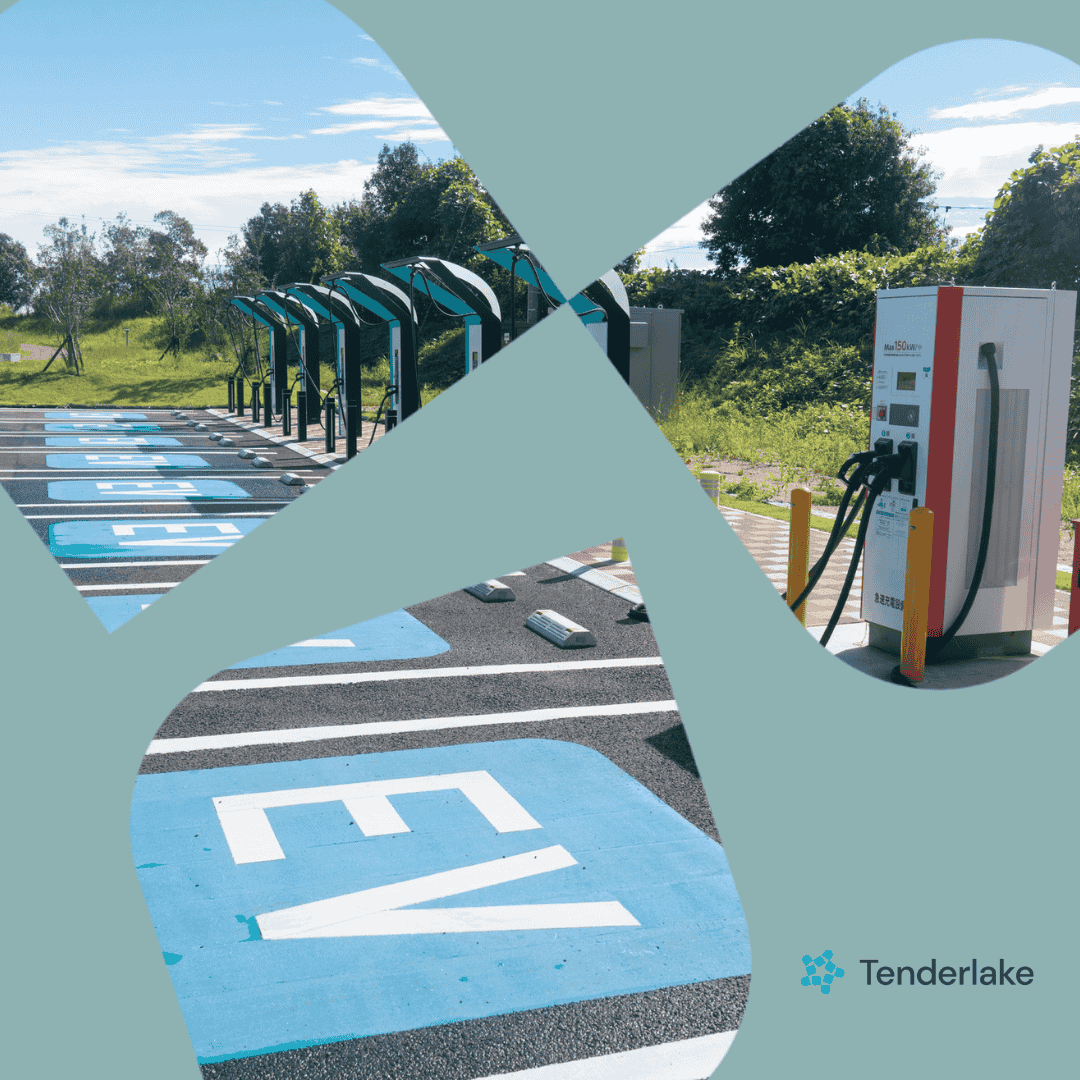
Major Power Utility Opens Tender for New EV Charging Infrastructure
A new design-and-build contract for e-chargers and equipment installation highlights how public buyers are scaling dedicated infrastructure for growing EV fleets.
A new design-and-build contract for e-chargers and equipment installation highlights how public buyers are scaling dedicated infrastructure for growing EV fleets.
Follow Tenderlake on LinkedIn for concise insights on public-sector tenders and emerging procurement signals.
A major power utility is moving deeper into electric vehicle charging, launching a design-and-build contract for new infrastructure that covers everything from planning to on-site installation. The project underlines how energy operators are starting to build dedicated charging capacity that can support more intensive use of electric vehicles, including commercial fleets.
On 9th December 2025, Holding Slovenske Elektrarne d.o.o. published a contract notice for E-Chargers and Equipment Installation. The scope is concise but clear: implementation of charging infrastructure, including design, supply of equipment and installation on site.
This is not a simple hardware purchase. By bundling design with delivery and installation, the utility is asking a contractor to take responsibility for shaping the technical solution, selecting and supplying the e-chargers, and integrating them into existing facilities. That approach is becoming common where charging must fit around power constraints, site layouts and safety requirements.
The notice also states that a site visit is mandatory for bidders. That requirement points to a complex physical environment, where detailed understanding of existing buildings, cabling routes and operational patterns will be essential before a credible solution can be priced and proposed.
Although the notice does not spell out the number, type or power levels of the chargers, the insistence on integrated design and on-the-ground inspection suggests infrastructure that goes beyond a few stand-alone posts. It looks geared towards sustained, repeated charging rather than light, occasional use.
The structure of this contract mirrors a wider move towards turnkey charging projects, especially where fleets or large sites are involved. Public buyers are increasingly packaging several stages into a single procurement:
In June 2025, public transport operator Transports publics fribourgeois Trafic (TPF TRAFIC) SA launched an Electric Bus Charging Equipment contract that combines supply and maintenance of chargers needed to decarbonise its vehicle fleet. There, as in the Slovenian utility’s project, the technical solution and the long-term operability of the system are treated as one problem to solve.
A similar pattern appears in the Charging Infrastructure Procurement launched by PaderSprinter GmbH in November 2025. That contract covers planning, delivery and installation of charging infrastructure at the operator’s site in Paderborn, alongside maintenance services for electric buses. The buyer expects a supplier that can design around depot operations as much as around electrical capacity.
In August 2025, PROMET d.o.o. went further still, seeking project-technical documentation and construction of Electric Bus Charging Infrastructure for city buses on a turnkey basis. There again, design and build are inseparable.
By choosing a similar integrated route for its e-chargers, Holding Slovenske Elektrarne d.o.o. is signalling that it wants a coherent scheme, shaped around its own sites and power assets, rather than a catalogue-driven purchase.
Many of the more ambitious charging procurements now link directly to vehicle fleets. In July 2025, Miasto Białystok published a contract for the Supply of Electric Buses and Chargers, combining 60 new city buses with 15 charging stations, staff training and warranties. Burgasbus EOOD adopted a similar approach in November 2025, procuring two 18-metre electric buses with charging stations and full installation, testing and training under its Electric Buses for Public Transport contract.
Other authorities are concentrating on public-access infrastructure. In June 2025, Københavns Kommune’s finance administration issued a notice for Charging Stations Installation and Operation on municipal roads. That tender covers installation, operation and maintenance of public chargers, with evaluation based on price and quality, and with explicit reference to compliance with the Alternative Fuels Infrastructure Act.
Helsingin kaupunki is pursuing yet another model. Its August 2025 procurement for Electric Vehicle Charging Stations on city-owned land seeks a supplier responsible for the entire service from design to maintenance, while the city provides space and permits but no financial involvement. Here, public authorities enable infrastructure without bearing investment risk.
Regional coordination is also visible. The Department of Sarthe’s October 2025 contract for Electric Vehicle Charging Infrastructure spans supply, installation, maintenance and supervision of charging points across multiple municipalities. This kind of pooled procurement is one route to a more consistent network.
Against that backdrop, the Slovenian utility’s project sits closer to the fleet- and site-focused end of the spectrum. It is about building dependable, grid-linked charging where it controls the energy supply, rather than about spreading a large number of low-power public points. Such infrastructure is a prerequisite for heavier daily use of electric vehicles, including vans, buses and specialist vehicles.
Another clear trend is the move beyond basic charging posts to smarter, more integrated systems. In October 2025, VALENCE ROMANS MOBILITES issued a tender for an Electric Charging System for Valence, which explicitly couples charging hardware with smartcharging software for an operating centre serving current and future electric buses. The goal is to support operations while minimising disruption to public transport services.
Software is gaining prominence as a procurement topic in its own right. Technologie hlavního města Prahy, a.s. went to market in October 2025 with a framework agreement for Charging Station Management Software, covering services to manage and operate charging stations and administer electricity sales for e-mobility in Prague. Here the physical infrastructure already exists or is procured separately; the focus is on operating it efficiently and fairly.
Integration with on-site energy storage is also emerging. In November 2025, free heating s.r.o. sought the Supply of Charging Stations and Battery Storage, including accessories, transport, technical documentation and expert supervision. Combining chargers with batteries can ease demand on local grids and smooth peaks, especially at depots.
Framework agreements offer yet another procurement tool. In September 2025, CPI eMobility, a.s. issued a notice for Charging Stations Supply and Installation, seeking framework agreements for AC and DC charging stations with a five-year warranty and call-offs based on need and renewed competition. In November 2025, PRO EMV, s.r.o. followed with a framework for the Supply of Electric Vehicle Charging Stations in three power variants. These arrangements give buyers flexibility to expand networks without re-tendering every site.
By comparison, Holding Slovenske Elektrarne d.o.o. has opted for a single, defined implementation project. But the emphasis on careful design and on-the-ground assessment means the resulting infrastructure could provide a platform for later layering of software, storage or expanded capacity if required.
The Slovenian notice leaves several questions open. It does not specify how many chargers will be installed, what power levels they will support, or whether ongoing maintenance will sit with the contractor or the utility’s own teams. Nor does it state whether this is a first phase or part of a wider roll-out.
Even so, the procurement fits a clear pattern: public and semi-public bodies are no longer buying chargers as standalone devices. They are commissioning tailored infrastructure that must mesh with depots, offices, streets and power systems, often with long-term performance and fleet operations in mind.
Once the contract is awarded and detailed designs are agreed, the resulting scheme will show how one major power operator chooses to structure its role in electric vehicle charging – and how far it is prepared to go in building out the infrastructure that future electric fleets will rely on.
Tenderlake Monitor reads every public sector notice published across the UK, the EU and the EEA, in the language it was published in, and tells you which ones match what your company sells and why. It works from a plain description of your business, not from keywords or CPV codes.
Follow Tenderlake on LinkedIn for concise insights on public-sector tenders and emerging procurement signals.