Hospitals prepare for shared AI imaging models under new public contract
New imaging AI models will feed into a central e-health platform, showing how public buyers are reshaping diagnostics and data use with shared tools.
New imaging AI models will feed into a central e-health platform, showing how public buyers are reshaping diagnostics and data use with shared tools.
Follow Tenderlake on LinkedIn for concise insights on public-sector tenders and emerging procurement signals.
Centrum e-Zdrowia is moving to deploy shared artificial intelligence models for medical imaging as part of the e-Health KPO project. The plan is to plug those models into existing digital platforms so that hospitals can access consistent diagnostic support tools while they continue to modernise their own imaging and records systems.
In December 2025, Centrum e-Zdrowia published a contract notice for AI models for imaging data as part of the e-Health KPO project. The contract covers the delivery and maintenance of artificial intelligence models that analyse medical images, together with integration into the Intelligent Services Platform and training for the staff who will use them.
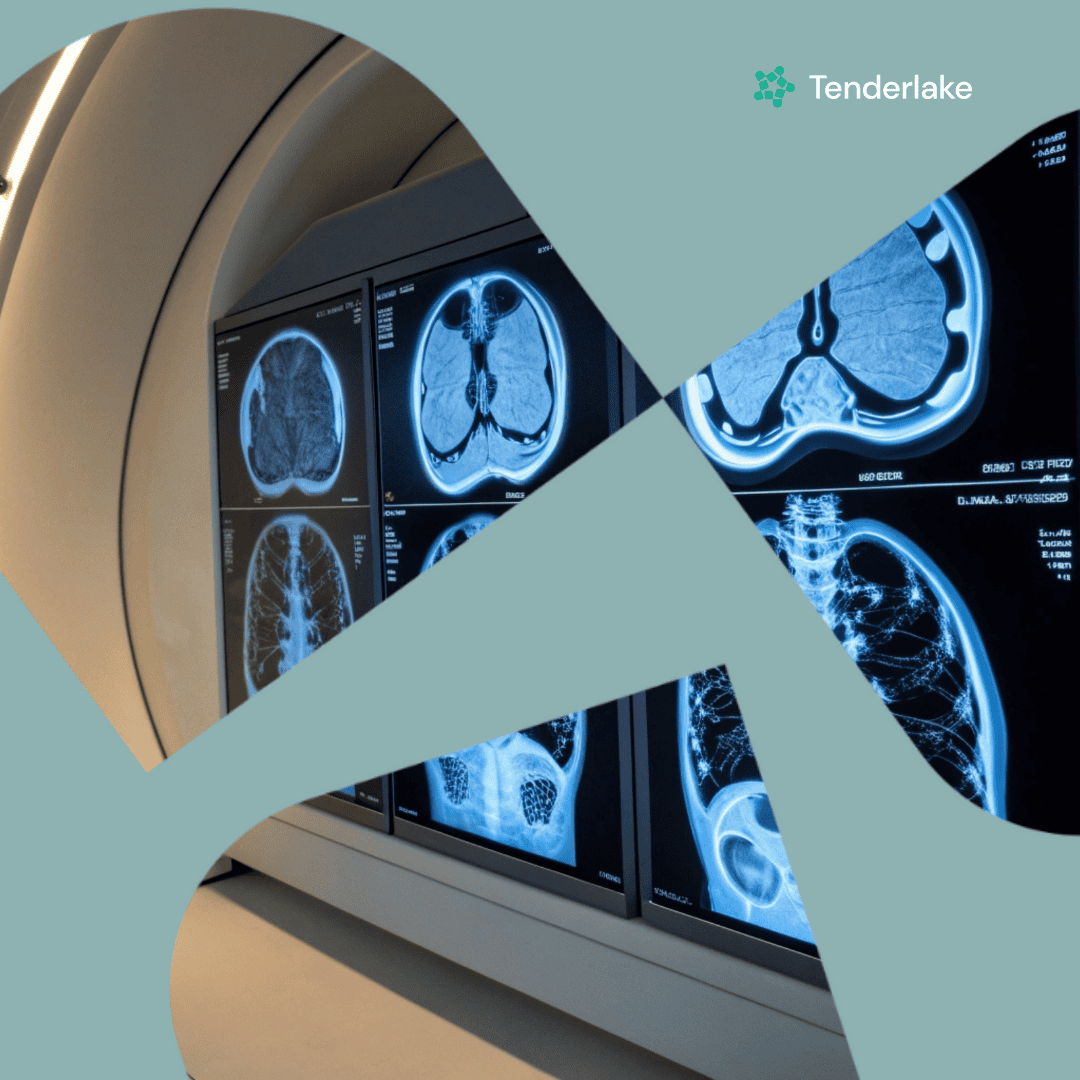
The notice positions the models squarely in medical diagnostics. They are expected to support tasks ranging from detecting pathologies in chest CT scans to helping diagnose breast neoplasms, pointing towards use in radiology and oncology where clinicians work with large volumes of complex imaging data.
Rather than treating each model as a separate purchase, the buyer is bundling the main components into a single, centrally managed service. The contract brings together:
With integration to the Intelligent Services Platform specified in the notice, the new models are intended to be available to systems that already connect to that platform. In effect, Centrum e-Zdrowia will provide common diagnostic building blocks that other institutions can adopt through their own software.
In parallel, hospitals are reshaping their own systems to plug into shared platforms and AI services. In November 2025, Samodzielny Publiczny Zakład Opieki Zdrowotnej Szpital im. dr. J. Dietla w Krynicy-Zdroju went to market for an IT solution to modernise the hospital's domain systems so that data can be integrated with the Intelligent Services Platform and AI used to enhance diagnostic and therapeutic processes. In December 2025, Dolnośląskie Centrum Onkologii, Pulmonologii i Hematologii issued a contract for the delivery, implementation and integration of IT systems, combining medical documentation digitisation with integration to the same platform, plus testing, training and technical support.
Other notices tackle the imaging stack more directly. Samodzielny Publiczny Zakład Opieki Zdrowotnej w Łapach has tendered to integrate its PACS system with PUI and extend the RIS/PACS system with AI modules, alongside buying a server and securing technical support. Wojewódzki Specjalistyczny Szpital Dziecięcy im. św. Ludwika w Krakowie is buying an AI imaging documentation solution that integrates with the CeZ system and adapts existing HIS, RIS and PACS systems. SZPITAL PRASKI P.W. PRZEMIENIENIA PAŃSKIEGO SPÓŁKA Z OGRANICZONĄ ODPOWIEDZIALNOŚCIĄ plans to replace its RIS system and upgrade PACS servers with AI capabilities, ensuring full integration with the hospital system and enabling remote examination reviews.
These projects illustrate how local systems are being readied for centrally provided services. Hospitals are digitising documentation, connecting to shared platforms such as the Intelligent Services Platform or CeZ system, and upgrading RIS and PACS environments so that when tools like the new imaging models arrive, they can be embedded into routine workflows rather than bolted on at the margins.
The focus on imaging sits within a broader wave of clinical AI projects. In June 2025, Universitair Ziekenhuis Brussel launched a tender for AI models for automatic analysis and interpretation of medical communication, centred on speech-to-text and features such as patient transfer support, suggestions for actions during care and remote assessments via smart glasses, all within a web-based application. In July 2025, МЕДИЦИНСКИ УНИВЕРСИТЕТ sought a web-based information system that uses AI to analyse and interpret medical data, with tools for visualisation, processing, management and integration with other systems.
Meanwhile, radiology departments are procuring targeted AI tools. In November 2025, Spital Clinic Judetean de Urgenta "Pius Brinzeu" Timisoara advertised an AI-based software module for automatic analysis of chest X-rays and lung CT scans to enhance accuracy and efficiency in radiology. In December 2025, Zachodniopomorskie Centrum Onkologii issued an e-services implementation notice that combines IT system integration, medical documentation digitisation, security enhancements and AI solutions, funded by an EU initiative.
Taken together, these procurements show public buyers embedding AI into specific workflows – from reading scans and managing oncology records to transcribing clinical conversations – while expecting vendors to handle integration into existing web and hospital systems.
Beyond frontline health providers, central institutions are investing in the platforms, infrastructure and skills needed to support AI. Several recent procurements centre on core environments for running models and analysing data:
Other notices highlight the supporting layers. In November 2025, Centrum Informatyki Resortu Finansów sought the delivery of switches for an AI environment, including implementation work, up to 200 man-hours of technical assistance and confirmation of manufacturer warranties. In October 2025, Ministerstwo Cyfryzacji launched a framework for 12,000 AI Laboratory Kits for primary and secondary schools across 73 territorial units, indicating a push to build hands-on familiarity with AI technologies among students as the public sector scales up its own use.
Against this backdrop, Centrum e-Zdrowia’s imaging models are a keystone in a wider public-sector architecture for AI. The contract aims to place sophisticated diagnostic support – from chest CT analysis to assistance in diagnosing breast neoplasms – on a shared platform that many hospitals are already preparing to connect to. Future documentation on the e-Health KPO project and related hospital tenders will show how quickly these models move from procurement to everyday clinical use.
Tenderlake Monitor reads every public sector notice published across the UK, the EU and the EEA, in the language it was published in, and tells you which ones match what your company sells and why. It works from a plain description of your business, not from keywords or CPV codes.
Follow Tenderlake on LinkedIn for concise insights on public-sector tenders and emerging procurement signals.