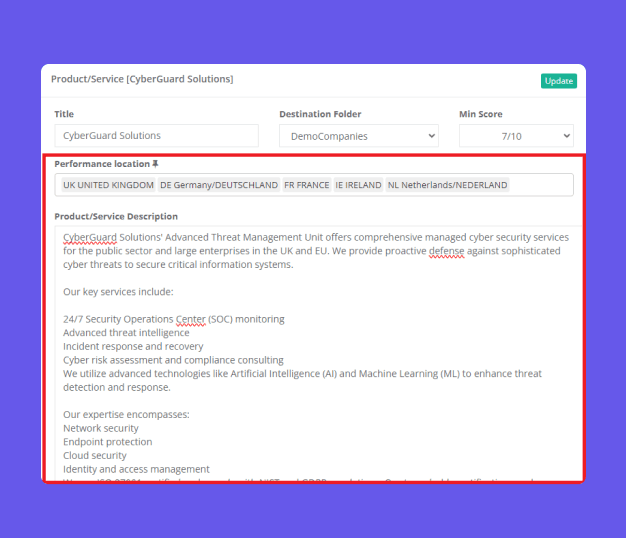
Describe your services in plain language. Tenderlake Monitor finds every relevant contract, in any language, and tells you exactly why each one matches – scored, explained and risk-flagged.
Tenderlake Monitor assesses opportunities against your capabilities, explains the match in plain English, and flags potential requirement risks – even when buyers use completely different wording.
Describe your services with scope, tools and exclusions. Tenderlake Monitor evaluates each opportunity and explains the fit – like a strong bid professional reviewing at scale.
One description surfaces relevant notices across all European languages, with everything presented in English for fast triage.
Just describe your products and services in the way you describe them to a prospective customer or an assistant. No need to fiddle with keywords or CPV codes.
(you can if you want). Learn More
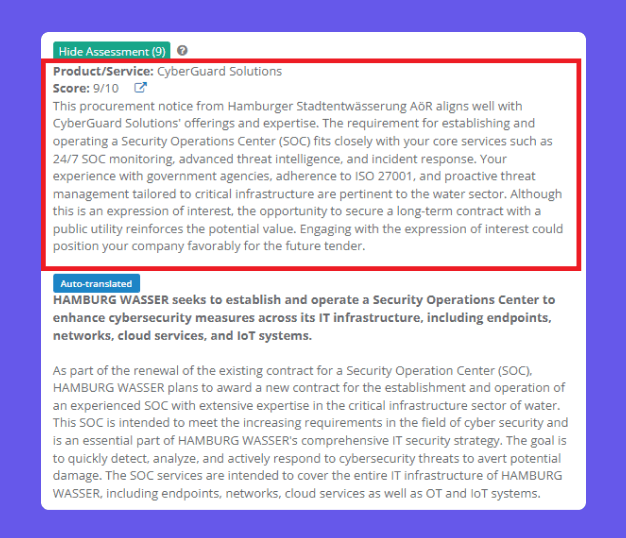
Tenderlake understands what every procurement is about, how your products and services fit, and explains it in plain language. Even when the buyer uses none of the words you use. Learn More
Request demonstration
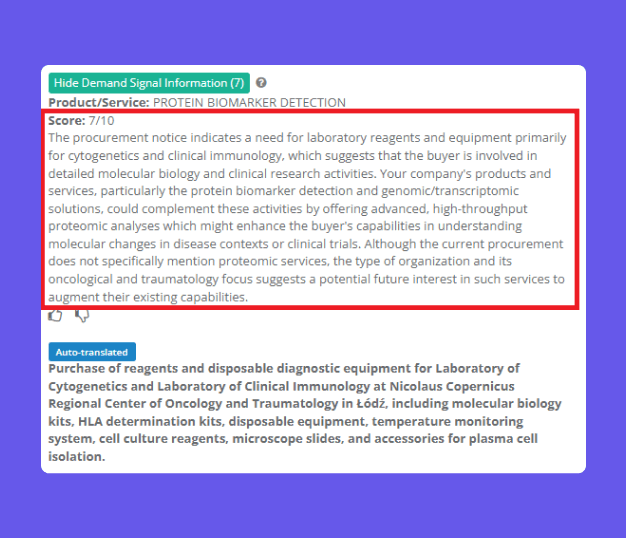
Who has a (not yet announced) need for your products and services – and why? Learn More
Request demonstration
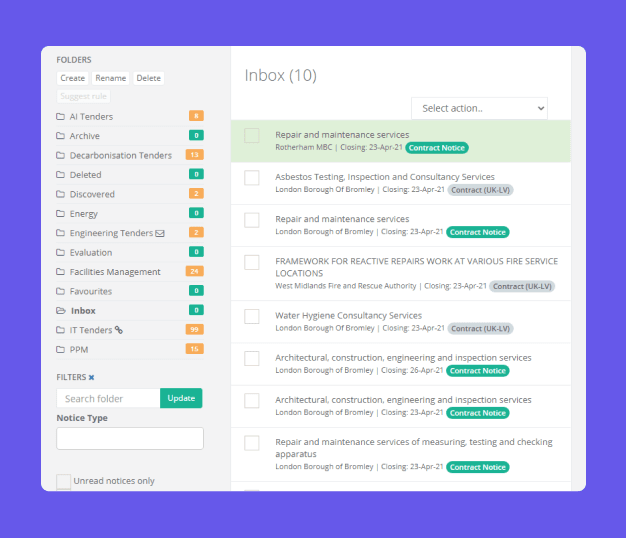
Tenderlake makes it easy to create and manage an efficient tender pipeline that delivers all relevant tenders and market intelligence.
Request demonstration
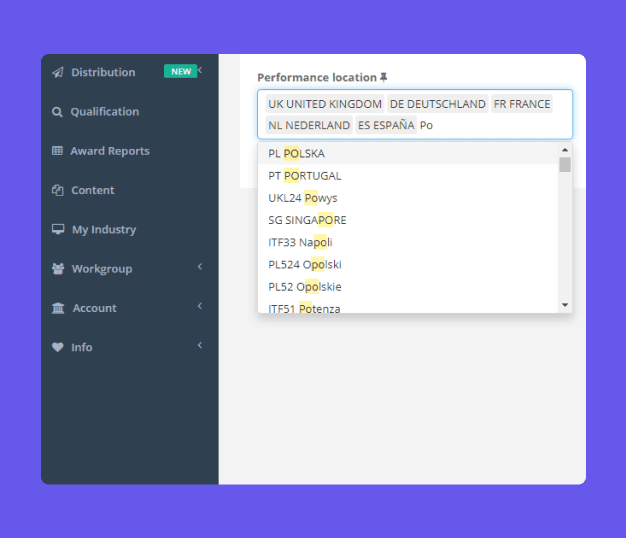
Full coverage of UK/EU/EEA. Also US/CA federal coverage, World Bank, and much more.
Request demonstration
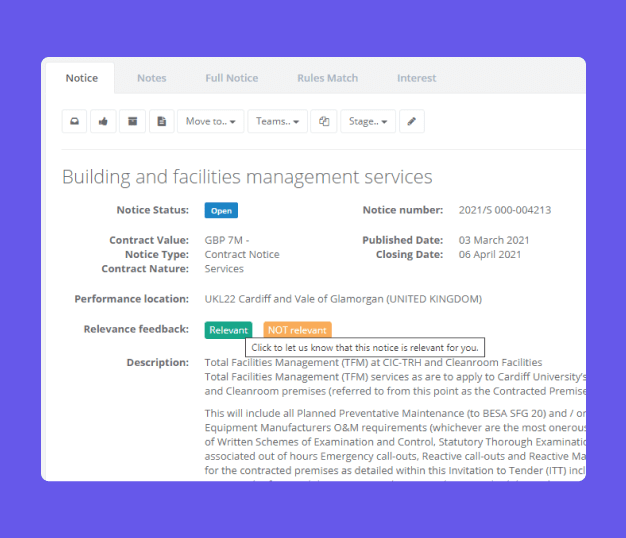
Tenderlake automatically learns the preferences and interests of every single stakeholder throughout your organisation, to identify additional relevant opportunities, no one is actively searching for.
Request demonstration
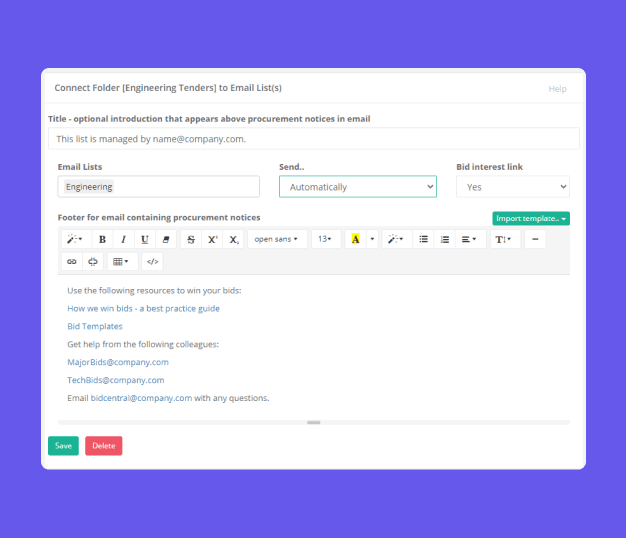
Create rules for internal distribution and put the tenders that are relevant for your colleagues in their inbox; bespoke to their needs.
Request demonstration

Create rules for distributing tenders to specific channels in Microsoft Teams or Slack.
Request demonstration
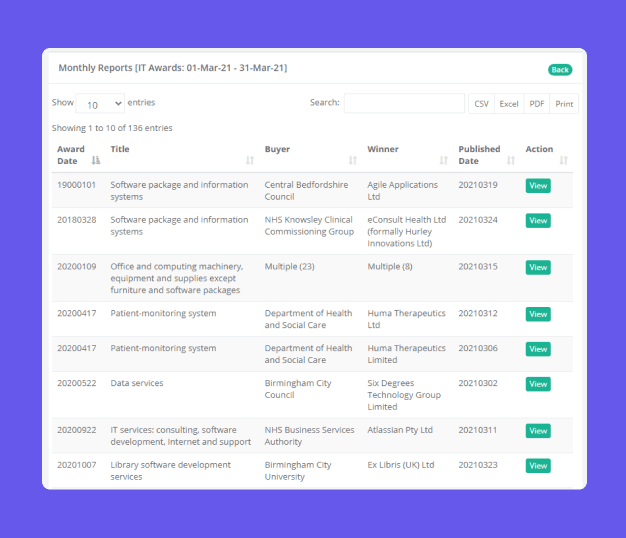
Track awards to competitors, find partners and a wealth of business development opportunities.
Request demonstration
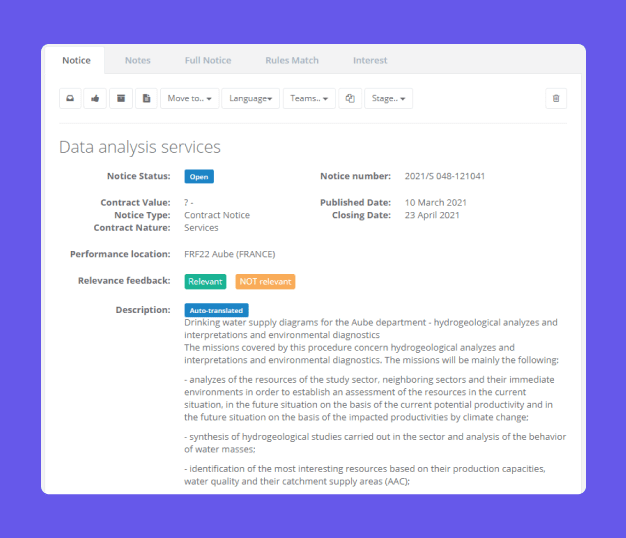
Search for, and qualify, opportunities in English even if the contract is published in other languages. No need for searches in the local language.
Request demonstration
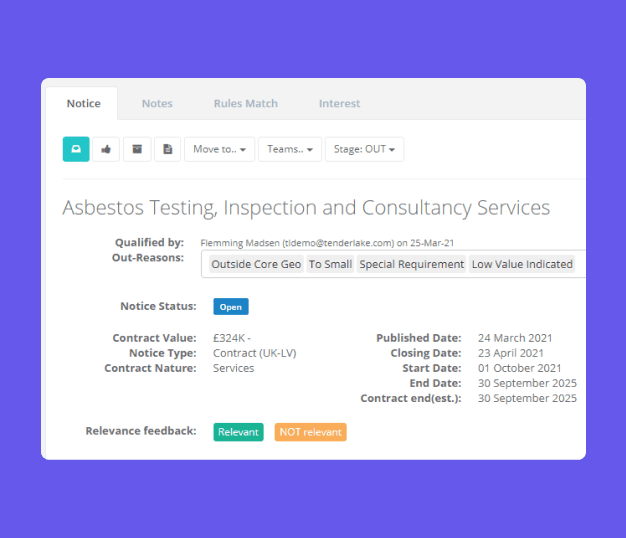
Quickly qualify procurement opportunities in or out and assign bid stage. Makes it easy to report on aggregated reasons for qualifying out and helps highlight the work that goes into sourcing and qualifying tender opportunities.
Request demonstration
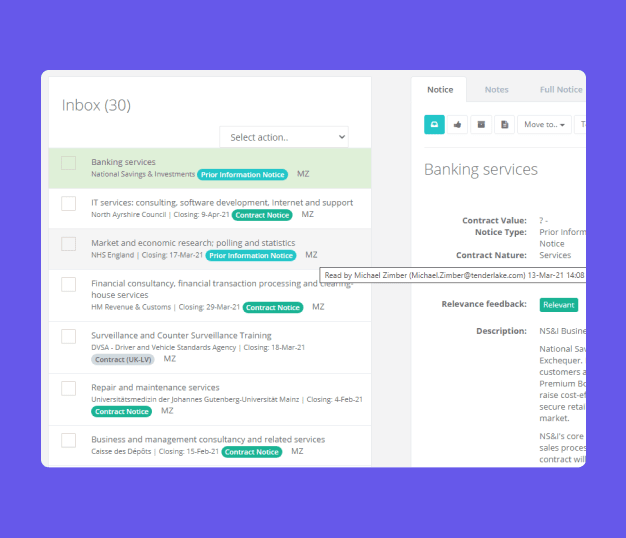
Speeds up daily work and supports game-changing collaboration.
Request demonstration
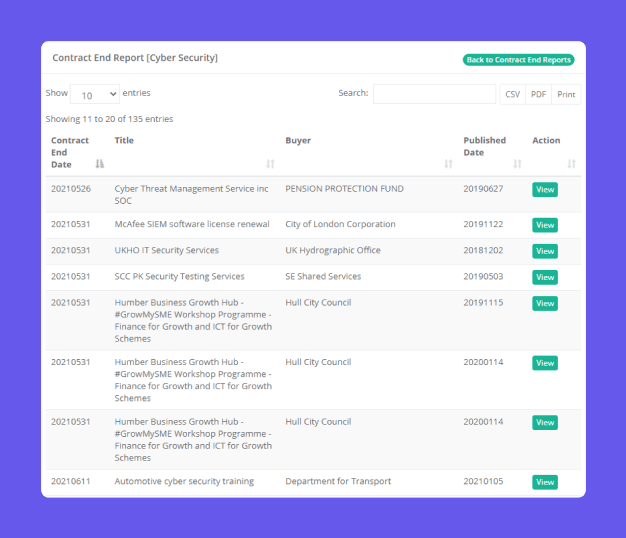
Clearly see which contracts are likely to come up for renewal in the next 24 months. Perfect for business development activities.
Request demonstration
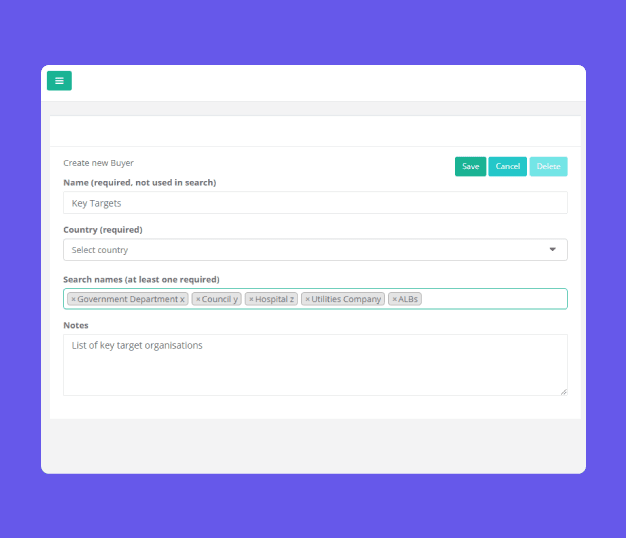
Be alerted when your key targets put out new notices. Works for individual organisations or types of organisations, e.g. universities, councils or hospitals, etc.
Request demonstrationCustomer Testimonial

"Until we discovered Tenderlake’s powerful public tender discovery and distribution platform we were spending up to 30 mins a day or 2 full days a month sifting through poor CPV and Boolean key word search generated results from the usual platforms.
In Tenderlake, we were looking for a solution that would allow us to drive up the number of meaningful search results and drive down the effort it took to check sort and distribute them.
Tenderlake has helped us reduce time spent dealing with search results from a few hours a week to under 5 minutes a day.
Tenderlake has a unique combination of intuitive powerful search building tools, and an AI that has quickly learnt how to differentiate and deliver relevant opportunities.
We were nervous about missing out on key opportunities so ran the service in tandem, over 2 months, with a current market leader in public tender searches and a human basis lead generation service. Tenderlake, in this period, has not missed a single relevant opportunity and has in fact surfaced relevant multimillion pound opportunities the other services missed.
While the technology is impressive, and finds more relevant opportunities faster, it is the human touch from a team who genuinely care about helping us do more with our time that further sets Tenderlake head and shoulders above their competition.
The customer service we receive is second to none, while the constant innovation of this excellent platform means as we have every confidence that Tenderlake will remain a core part of how we manage public sectors tenders for the foreseeable future."![]()
Senior Bid Consultant
See the opportunities matched to your business before committing to anything. No card required.
Start a free trial Download the brochurePrefer a walkthrough? Get a demo
Tenderlake Monitor is built for consultancies, engineering groups, systems integrators and complex solution providers where public sector work is strategically important. It delivers the greatest value to organisations operating across multiple regions and competing for high-value, outcome-led tenders where missing one opportunity carries real commercial risk.
That is the finding side of the job. If the question is which buyers and markets to pursue in the first place, rather than which tenders to bid for now, that is what Tenderlake Analyst answers.
Tenderlake Monitor is not intended for companies that bid occasionally, rely on commodity supply, operate only in a small local market, or are satisfied with basic keyword alerts. It is designed for organisations that treat public sector revenue as a core growth engine rather than an opportunistic channel.
Procurement language varies significantly across countries, even when the underlying need is similar. Maintaining keyword strategies in multiple languages is fragile and incomplete. Tenderlake Monitor allows you to describe your capability once and gain structured visibility across multiple markets without rebuilding your monitoring approach for each jurisdiction.
That covers what is open now across those markets. Judging which of them is worth the investment – who is already winning there, which buyers are active and whether spend is growing – is what Tenderlake Analyst is for.
Yes. Central teams gain strategic oversight and consistent visibility, while local experts can assess opportunities relevant to their specific services or sectors. This reduces duplicated monitoring effort and improves coordination across regions.
Yes. By removing language and terminology barriers, Tenderlake Monitor makes it possible to explore new procurement markets without building new keyword libraries or local search processes. This supports structured, lower-risk market entry.
Sizing a market before you commit to it – the incumbents, the active buyers and the routes they buy through – is a different question, and one Tenderlake Analyst answers from more than a decade of award history.
Yes. Tenderlake Monitor has recently expanded to include federal procurement data from the United States and Canada. This data is currently available in beta with free access while we gather feedback. Users can opt in to activate US and Canadian coverage and decide later whether to include it in their subscription. Read the full announcement.
You describe your products or services in natural language, as you would explain them to a knowledgeable colleague. You can include scope, methodologies, tools, exclusions and technical nuance. Tenderlake Monitor builds a structured capability model from this description and evaluates procurement notices against it in detail.
Yes. Precision improves relevance. You can specify modelling tools, platforms, regulatory approaches, delivery boundaries and what is explicitly out of scope. Tenderlake Monitor uses this detail to strengthen alignment and reduce false positives.
Public sector buyers describe outcomes in varied language. The same requirement can appear under different terminology across sectors and countries. Tenderlake Monitor evaluates meaning and capability alignment rather than relying on surface word matches, which allows it to identify opportunities that static keyword lists fail to capture.
Yes. Each identified opportunity includes a clear explanation of how it aligns with your described capabilities. This enables rapid, informed triage rather than manual interpretation of dense procurement text.
Yes. Where appropriate, Tenderlake Monitor signals elements that may fall outside your stated scope or require further assessment. This supports disciplined bid selection and reduces wasted effort.
CPV codes are broad and inconsistently applied. Keyword filters assume stable vocabulary. Complex advisory, engineering and technology services are often described in outcome-led language that shifts across buyers and countries. As a result, purely keyword-based monitoring creates blind spots.
Tenderlake Monitor does more than match similar text. It models your capabilities and evaluates each procurement notice individually, generating structured reasoning about relevance. The result is closer to an experienced bid professional reviewing opportunities at scale.
No. A single structured service description can be used to identify relevant opportunities across multiple European languages.
Yes. Procurement notices published in other languages are translated into English to enable efficient initial assessment and consistent internal review.
Tenderlake Monitor evaluates meaning rather than direct word equivalence. This allows it to recognise alignment even when terminology differs significantly across countries and languages.
Yes. One well-structured description can support monitoring across multiple jurisdictions, allowing you to treat Europe as a single procurement landscape rather than fragmented language silos.
Yes. Tenderlake Monitor is useful for both. Many suppliers can describe a clear product or service and benefit straight away. But it is especially valuable for organisations whose offer is based on capability, expertise, experience, and delivery support. These firms often struggle with keyword and CPV search because buyers describe outcomes and problems to solve, not the supplier's own preferred terms.
A capability-based service is an offer built around specialist skills, judgement, experience, and applied expertise rather than a simple packaged product. Examples include consultancies, technical advisers, programme support teams, engineering design specialists, cyber advisers, and other expert service providers. They may have named services, but what clients really buy is the ability to solve complex problems.
Keyword search depends on the buyer using the same words as the supplier. That often does not happen. A supplier may describe its offer in terms such as advisory support, programme design, business cases, delivery assurance, or specialist analysis. A buyer may describe the need as a housing improvement programme, a healthier homes initiative, an estate roadmap, or an investment planning exercise. The commercial fit may be strong, even when the wording is very different.
Because buyers usually describe what they need to achieve, not how a supplier would describe its own capability. They often write about outcomes, priorities, programmes, funding, compliance, or operational problems. That creates a gap between supplier language and buyer language. Traditional search tools rely heavily on direct term overlap, so relevant opportunities are easy to miss.
Not fully. CPV codes can be useful, but for many capability-based suppliers they are too broad or too rigid. A consultancy or expert services firm may work across several domains, and no small set of CPV codes captures the real shape of the business without either missing good opportunities or bringing in too much noise.
Tenderlake Monitor allows the organisation to describe what it really does in plain language. That description can include the outcomes it helps deliver, the type of work it undertakes, the expertise it brings, and the boundaries of the offer. Tenderlake then uses AI to match that description to relevant procurement opportunities based on meaning and context, not just matching words.
No. That is one of the main advantages. Buyers and suppliers often describe the same need from different angles. Tenderlake Monitor is designed to bridge that gap. A supplier can describe its capability clearly once, and Tenderlake can identify relevant tenders even when the buyer uses different terms or frames the requirement in terms of outcomes.
No. Consultancies are a strong example because the problem is easy to see, but the same issue affects many suppliers of expert or capability-led services. That includes engineering advisers, cyber specialists, programme management teams, digital transformation firms, policy advisers, transport planners, healthcare advisers, and other organisations whose value lies in expertise rather than a single packaged product.
Yes. Tenderlake Monitor is relevant for both clearly defined offers and broader capability-based services. If you sell a well-defined product or service, you can describe it clearly and benefit from strong matching. If you sell a more blended or capability-led offer, Tenderlake can still represent that accurately and help surface relevant tenders that traditional keyword search may miss.
A good description should explain what you help clients achieve, what work you typically undertake, what expertise you bring, what types of organisations you support, and where the boundaries are. Plain language is better than marketing language. It also helps to state exclusions where relevant, such as whether you advise on a subject but do not supply hardware, carry out installation work, or provide operational delivery services.
Yes. A decarbonisation consultancy is a good example. It may help public bodies with estate decarbonisation strategy, retrofit planning, business cases, funding support, procurement support, and delivery assurance. A buyer may publish a tender for healthier homes, housing improvement, estate planning, or sustainability support without using any of those exact terms. That makes keyword search difficult, but it is a strong fit for AI-based matching.
Because broad search terms often pull in notices that share a word but not the real requirement. Searches for terms such as energy, retrofit, sustainability, digital, or transformation can bring in hardware supply, software, installation works, facilities management, or unrelated advisory contracts. This creates noise and wastes time.
By using the meaning of the full description rather than just isolated keywords. When your description explains what you do and what you do not do, Tenderlake Monitor has a stronger basis for judging whether a notice is commercially relevant. That helps reduce the volume of superficially similar but poor-fit opportunities.
Yes. Many capability-based firms sit across several areas at once, such as strategy, technical advisory, programme support, procurement, analysis, and delivery assurance. That is difficult to represent with a small set of keywords or CPV codes. Tenderlake Monitor can model a blended offer more naturally through a clear written description.
The main advantage is that you no longer have to guess every possible way a buyer might describe your expertise. Instead of building and maintaining a complex search logic, you describe the business you actually have. Tenderlake Monitor then matches opportunities by relevance and context, helping you find tenders that conventional keyword search can miss.
Often, yes. Many suppliers use AI Searches to describe the products and services they currently sell. That is useful, but it may not capture opportunities for R&D, innovation projects, pilot schemes, feasibility studies, prototypes, or bespoke work that the organisation is capable of delivering even if it is not part of the current product catalogue. In these cases, a separate capability-focused AI Search can help identify tenders based on expertise, experience, and technical capability, not just current offerings.
If your AI Search only describes what you currently sell, it may not fully represent what your organisation could develop, adapt, or contribute to in an R&D or innovation-led procurement. Some buyers are not looking for an off-the-shelf product. They are looking for suppliers with the capability and experience to solve a problem, run a project, or develop a new solution. A separate capability-focused AI Search can help capture those opportunities.
Personal AI Search is a Tenderlake Monitor Pro feature that helps each user find tender opportunities that match their own skills, experience, tools, and career goals. Instead of relying only on a central business unit description, it lets each person create a profile that reflects their individual expertise and receive tailored tender matches with an AI assessment explaining why the opportunity is relevant.
It is especially useful for professional services firms and other organisations where individual expertise varies across the team. In these environments, valuable capability often sits with specialists whose experience, technical tools, sector knowledge, or leadership background may not be fully captured in a standard service description.
A standard AI Search is usually based on a description of a business unit's services. Personal AI Search goes further by letting an individual user describe their own specialist skills, qualifications, software knowledge, interests, and goals. This helps Tenderlake Monitor identify opportunities that may be highly relevant to a specific consultant or expert, even if those details are not visible in the broader team description.
Because many organisations do not just sell fixed products or tightly defined services. They also sell capability, judgement, and specialist experience. It is hard for a central team to model every individual's expertise in search logic or keep track of every niche skill across the organisation. Personal AI Search allows that expertise to be represented directly and matched to relevant tender opportunities.
Yes. Personal AI Search is designed to match tenders based on meaning and context, not just direct keyword overlap. That means a consultant's experience, technical skills, leadership background, or specialist software knowledge can still be matched to a tender even when the buyer uses different wording to describe the requirement.
A strong profile usually includes core expertise and experience, key skills and interests, qualifications or background, relevant tools and software, and career goals or aspirations. It can also include caveats or exclusions to clarify what the user does not do or what kinds of engagements are less suitable.
Yes. Personal AI Search is designed to understand commonly used tools and software packages, so they can be included naturally as part of the profile. This is useful for technical and specialist roles where platform knowledge, modelling software, engineering tools, or analysis packages are relevant to the kinds of public sector opportunities a person can support.
The Pro user manages their own Personal AI Search. This gives individual consultants, account managers, and subject matter experts more control over how their own expertise is represented and how they monitor opportunities aligned with their work.
No. According to Tenderlake Monitor's guidance, a Personal AI Search is available as part of a Pro user licence and does not count towards the overall number of AI Searches available in the workgroup.
It helps organisations make better use of the full expertise they already employ. Instead of depending only on a central team to spot every relevant opportunity, Personal AI Search allows each specialist's knowledge, experience, and ambitions to contribute to opportunity discovery. This can uncover strong-fit tenders that might otherwise be missed, improve engagement from consultants and experts, and strengthen the organisation's ability to pursue relevant bids.
Submit your question here and we will get right back to you.