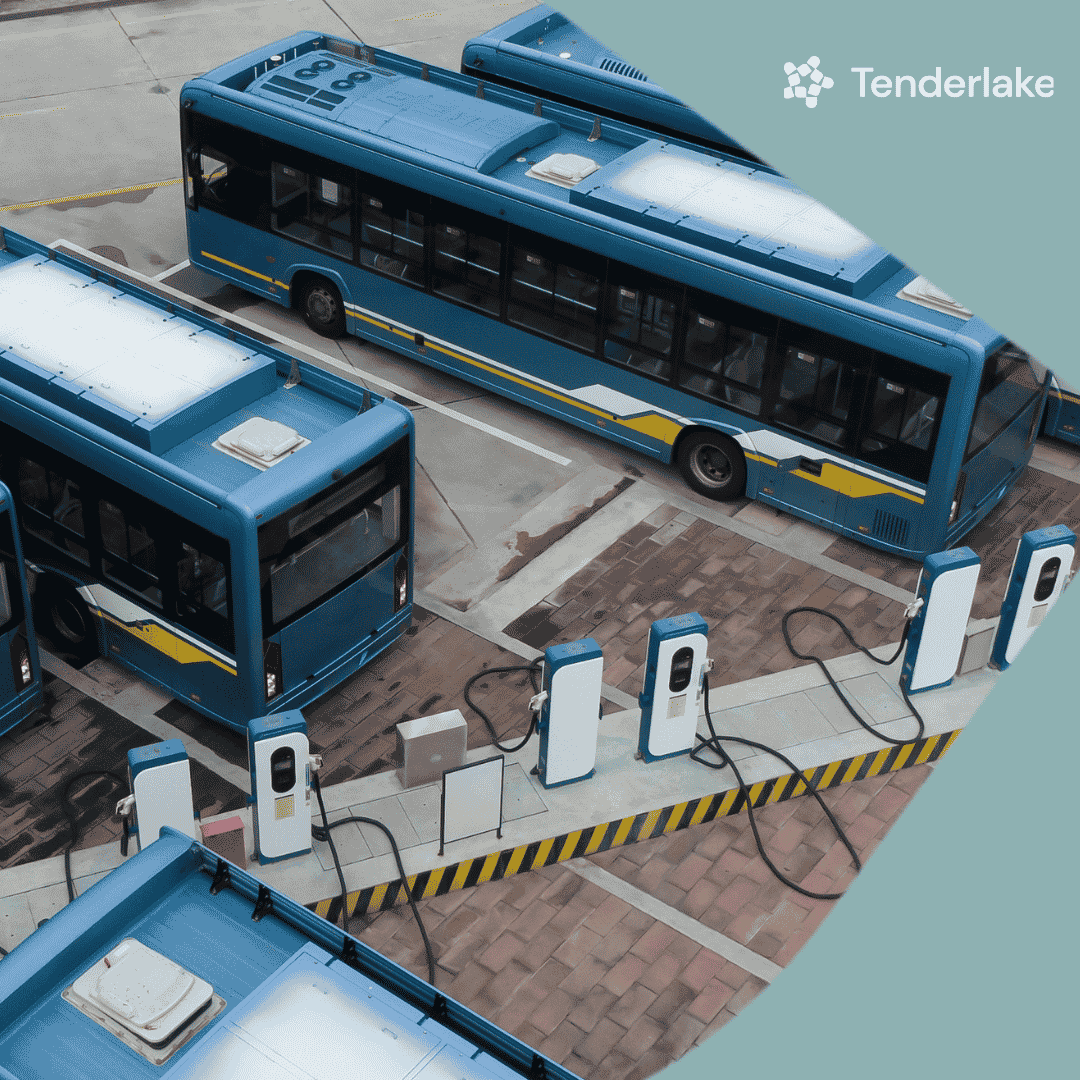
Energy utility launches tender for bus depot transformer station
Contract focuses on delivering and maintaining a transformer station for a new electric bus charging park, signalling growing demand for heavy-duty EV charging.
Contract focuses on delivering and maintaining a transformer station for a new electric bus charging park, signalling growing demand for heavy-duty EV charging.
Follow Tenderlake on LinkedIn for concise insights on public-sector tenders and emerging procurement signals.
Oberger Energie & Infrastruktur GmbH is procuring services to establish a charging park for battery electric buses, centred on a transformer station that must be delivered, assembled, commissioned and maintained. The charging park for battery electric buses will put in place the electrical backbone for high-capacity depot charging and reflects a broader wave of tenders for bus electrification and heavy-duty charging infrastructure.
In a contract notice published on 6th November 2026, the company sets out its need for services to establish a charging park dedicated to battery electric buses. The contract focuses on the delivery, assembly, commissioning and maintenance of a transformer station, rather than on charging columns or wider civil works.
This tight scope places the transformer station at the centre of the procurement strategy. The chosen supplier will not only deliver and install a critical grid asset but also bring it into operation and keep it running over time. For infrastructure contractors and specialist electrical firms, the opportunity lies in demonstrating both high-voltage expertise and the capacity to offer long-term maintenance.
Elsewhere, transport operators are opting for broader, turnkey approaches. On 8th July 2026, OK.go MobilitätsAG published its Construction of Covered Bus Depot contract, seeking a general contractor to plan, deliver, build and commission a full charging infrastructure and associated facilities for electric buses, including a transformer station and drainage systems.
On 31st August 2026, Söllner Reisen GmbH & Co. KG went to market for Charging Infrastructure Construction, specifying a DC charging system for battery-electric city buses with eight 100 kW charging points and a 1600 kVA medium-voltage transformer. That contract combines turnkey planning, delivery, construction, commissioning and maintenance in a single package.
Similarly, Busbetrieb Josef Ettenhuber GmbH is procuring a comprehensive charging system for battery-electric buses. Its Charging Infrastructure for Depots notice from 6th July 2026 covers planning, installation and maintenance across multiple lots.
Viewed against these broader tenders, Oberger Energie & Infrastruktur GmbH’s focus on the transformer station represents a targeted approach, concentrating on the core grid asset while other elements of the charging park sit outside the current contract scope.
Across the current pipeline, transformer stations and medium-voltage connections appear repeatedly in bus-charging projects. In several cases, the link between the wider grid and the depot is assigned to dedicated work packages with their own engineering requirements.
On 15th October 2026, Reisebüro Schmidt GmbH issued a Charging Infrastructure for Buses notice for its depot in Wolfenbüttel. The tender is split into three lots covering civil engineering, a medium-voltage transfer station and electrical installation, with bidders free to compete for individual or multiple lots.
Stadtwirtschaft Weimar GmbH is taking a similarly structured approach. Its Charging Infrastructure for Electric Buses procurement from 27th October 2026 covers planning, construction and commissioning of charging points, transformers and the necessary civil works at its depot. Implementation is planned in several phases, with optional maintenance services built into the contract.
Design-and-build models are also becoming common. On 12th October 2026, Dopravní podnik města České Budějovice, a.s. launched its Charging Infrastructure for Bus Depot contract using a design and build method that spans design, permitting, implementation and delivery of the charging system, along with five years of service support.
Some buyers explicitly link charging hardware with software and operational support. On 27th May 2026, Hausemann und Mager GmbH & Co. KG published a Charging Infrastructure for Electric Buses tender for low-floor vehicles that includes supply, installation and commissioning of chargers, a management system and support services aimed at enhancing sustainable public transport and reducing CO₂ emissions.
Within this context, Oberger Energie & Infrastruktur GmbH’s transformer-focused contract sits at the grid-heavy end of the spectrum. By bundling delivery, assembly, commissioning and maintenance of the transformer station, the buyer is signalling that reliable grid connection and long-term asset performance are treated as core requirements for its planned charging park.
The charging park project also lands amid a series of procurements that pair electric buses with new charging infrastructure. In these cases, fleet renewal and depot upgrades are treated as two sides of the same investment.
On 2nd June 2026, the Ministry of transport of Republic of North Macedonia launched a Electrical Buses and Charging Stations procurement covering 150 electrical buses and 75 charging stations. The scale underlines the level of ambition now attached to some electric bus programmes.
Several municipalities are taking an integrated path on a smaller scale. Primaria Orasului Buftea’s Electric Buses and Charging Stations Procurement from 17th August 2026 combines 10 electric buses with three fast charging stations for urban public transport, explicitly aiming to improve efficiency, cut emissions and promote sustainable mobility. The municipality of Cajvana, through its Electric Vehicle Charging Stations Construction notice from 9th September 2026, is procuring seven charging stations plus electrical installations and training for operational staff to strengthen its local network.
The city of Vratza is linking new vehicles and infrastructure even more tightly. Its Electric Buses and Charging Stations procurement from 29th May 2026 covers the delivery of electric buses in two sizes, fast-charging stations, registration procedures, warranty services and personnel training in a single contract.
Urban transport operators are following a similar pattern. On 4th November 2026, Miejskie Przedsiębiorstwo Komunikacyjne – Łódź Spółka z ograniczoną odpowiedzialnością issued an Electric Buses and Chargers Procurement for 20 new low-floor electric buses, 10 charging stations, workshop equipment, employee training and documentation to support its urban network. Miejski Zakład Komunikacji Sp. z o.o. is focusing on the depot side with its Electric Bus Charging Stations tender from 9th June 2026, procuring six dual charging stations for a depot, plus the infrastructure needed and an option for five additional units.
Even where buses are procured separately, the focus is firmly on electrification. On 9th September 2026, OBERGER Gesellschaft m.b.H. announced a Battery Electric Buses Procurement, stating that the acquisition would follow a transparent process similar to the Federal Procurement Act. Taken together with charging-infrastructure tenders, such notices indicate that buyers are planning for sustained adoption of battery electric fleets.
Against this backdrop, the Oberger Energie & Infrastruktur GmbH transformer contract is positioned to provide the depot grid connection needed for battery buses.
The tender for a charging park transformer also sits alongside a growth in public and workplace charging projects, which require comparable electrical and civil engineering capabilities.
MUNICIPIUL BOTOSANI’s Fast Charging Stations for Public Buildings contract from 1st June 2026 covers the procurement and installation of 27 fast charging stations at public buildings, aimed at enhancing energy efficiency and supporting Romania's National Recovery and Resilience Plan.
PUB GAS s.r.o. is procuring a network of workplace chargers through its Electric Vehicle Charging Stations Supply notice from 7th October 2026, which calls for the supply, assembly and installation of charging stations for 18 parking spaces in Brno-Černovice, with various power levels and the necessary infrastructure.
Municipal authorities are also looking to scale public charging networks. On 17th August 2026, Technická správa komunikací hl. m. Prahy, a.s. launched its Supply of Electric Vehicle Charging Stations framework, intending to appoint three suppliers to deliver and install public charging stations for electric vehicles in Prague, including related equipment and services.
Although Oberger Energie & Infrastruktur GmbH’s current contract is firmly focused on a bus depot, these wider initiatives sit in the same ecosystem. Taken together, depot charging parks and public charging networks place growing emphasis on grid connections and transformer capacity, and they rely on specialist contractors to deliver and maintain those assets.
The 2026 run of tenders for electric buses, depot infrastructure and public charging points shows that electrification is now a mainstream theme in fleet and transport planning. Contracts such as Oberger Energie & Infrastruktur GmbH’s transformer station for a charging park, with its emphasis on delivery, commissioning and ongoing maintenance, highlight the importance of robust grid connections as the foundation for this shift.
For suppliers, the message is clear: authorities and operators are looking for partners who can take responsibility for critical electrical assets over their full life cycle, not just for installing hardware. How Oberger Energie & Infrastruktur GmbH’s procurement is awarded and delivered will help show the role that specialist transformer expertise plays within the wider market for bus-charging projects.
Tenderlake Monitor reads every public sector notice published across the UK, the EU and the EEA, in the language it was published in, and tells you which ones match what your company sells and why. It works from a plain description of your business, not from keywords or CPV codes.
Follow Tenderlake on LinkedIn for concise insights on public-sector tenders and emerging procurement signals.