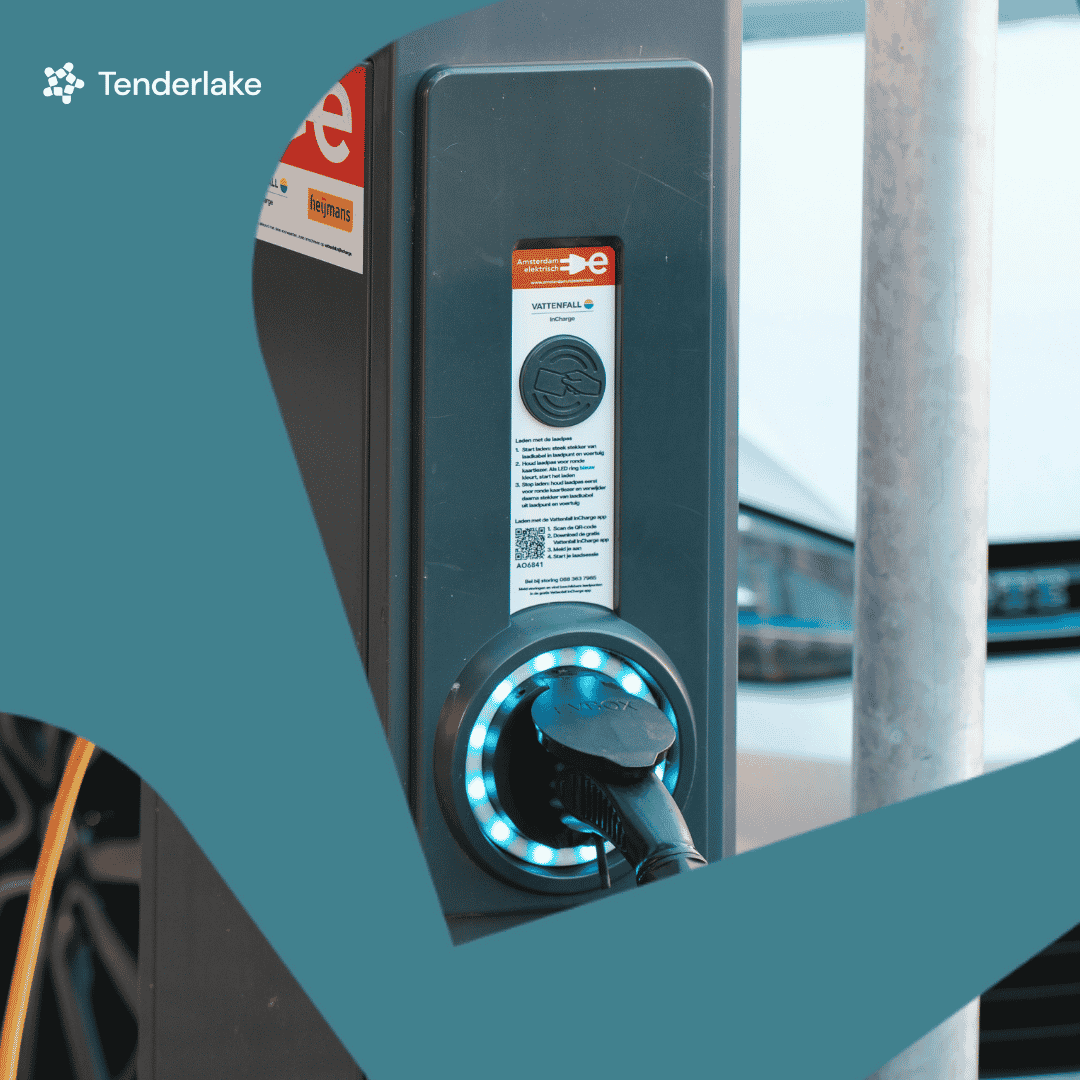
Energy body launches tender for regional EV charging network
A regional energy authority is seeking suppliers to deliver, install and commission new electric vehicle charging infrastructure across multiple sites.
A regional energy authority is seeking suppliers to deliver, install and commission new electric vehicle charging infrastructure across multiple sites.
Follow Tenderlake on LinkedIn for concise insights on public-sector tenders and emerging procurement signals.
Territoire d'Energie Lot-et-Garonne has gone to market for a programme to deploy electric vehicle charging stations across various parts of Nouvelle-Aquitaine, covering the supply, installation and commissioning of equipment, plus the supporting infrastructure and works. The move underlines how public buyers are now treating charging for electric and plug-in hybrid vehicles as core infrastructure to be rolled out at regional scale rather than as isolated pilot projects.
Published on 21st September 2026, the Electric Vehicle Charging Infrastructure contract notice sets out a programme to deploy charging stations for electric and plug-in hybrid vehicles in several regions of Nouvelle-Aquitaine. The scope runs from the delivery of charging hardware through to installation and commissioning, and includes the “necessary infrastructures and related works” needed to make the stations operational.
Although the notice does not spell out the number or exact locations of charging points, the focus on “various regions” indicates a distributed roll-out rather than a single large site. The inclusion of infrastructure and related works suggests that the supplier or suppliers will be expected to handle the enabling works alongside the installation itself, rather than leaving those pieces to separate contracts.
By covering both electric and plug-in hybrid vehicles, the programme clearly targets mainstream road traffic rather than niche fleets. It also places a regional energy body in a coordinating role, stitching together sites across different localities into a single procurement. That approach echoes a growing pattern in recent notices, where shared infrastructure is commissioned once and then made available to a wide range of users.
The Lot-et-Garonne notice is a straightforward works-focused contract, centred on deployment and commissioning. Other buyers have been opting for concession or framework models that bundle in long-term operation, revenue and risk.
In August 2026, the City of Limbourg launched a service concession under its Electric Vehicle Charging Stations notice. There, the concessionaire must finance, supply, install, operate and maintain public charging stations in the city, while carrying the associated risks and revenues. The public authority provides access to the public domain, but the private operator runs the network and recoups its investment through user fees.
In April 2026, Syndicat Départemental d'Energie de Seine-Maritime followed a similar path with its Public Charging Infrastructure Project, seeking a public service delegation to implement, finance and operate a network of charging stations. That delegation covers both the management of existing stations and the development of new charging points, signalling a shift from ad hoc installation towards network-wide stewardship.
Concession models are also appearing within large institutional estates. In July 2026, the Assemblée nationale issued its EV Charging Stations Project, seeking a concessionaire to carry out studies, deployment, operation and commercialisation of charging services at its own risk. Here, the buyer is less concerned with owning the infrastructure outright and more focused on securing a reliable service for users.
Alongside concessions, framework agreements are being used to create repeatable arrangements for installation and management. In April 2026, Département de la Drôme published a Charging Infrastructure for Vehicles framework, covering the supply, installation and management of charging stations for electric and rechargeable hybrid vehicles. The agreement explicitly includes civil engineering, electrical work, operational supervision and maintenance, allowing the authority to call off a full suite of services as needed.
In May 2026, Intercommunale IDEA took a similar but larger-scale approach in the Heart of Hainaut region. Its Electric Charging Stations Project covers the supply, installation, commissioning, operation and maintenance of 64 double charging stations and up to 28 single units. This blend of capital works and ongoing service provision gives the buyer a single contractual framework for the entire lifecycle of the network.
For territories where multiple authorities want to move together, joint purchase structures are emerging. In August 2026, the consortium led by SYNDICAT DEPARTEMENTAL D'ELECTRICITE SDE54 invited municipalities, inter-municipal bodies and other stakeholders in Meurthe-et-Moselle and Lorraine to join its Charging Stations for Electric Vehicles contract, which spans purchase, installation, maintenance and operation of charging points for electric and plug-in hybrid vehicles.
Against that backdrop, the Lot-et-Garonne contract stands out for its tight focus on deployment. The notice highlights supply, installation, commissioning and related works, without setting out revenue-sharing or long-term operating models in the same way as concession-based schemes. That distinction will shape which suppliers decide to bid and how they structure their offers.
While regional bodies focus on shared public charging, other buyers are targeting specific fleets and estates with tailored infrastructure.
In June 2026, Saint-Étienne Métropole launched a Smartcharging Solution for Electric Buses to support the transition of its bus fleet. The contract covers the provision, installation and commissioning of a charging solution with multiple charging points at two depots. Also in June 2026, Miejski Zakład Komunikacji Sp. z o.o. sought suppliers for Electric Bus Charging Stations, covering the supply, installation and commissioning of six dual charging stations at a bus depot, with an option for five additional units and all necessary infrastructure.
By July 2026, depot-focused investment had broadened further. Busbetrieb Josef Ettenhuber GmbH issued a Charging Infrastructure for Depots tender for a comprehensive charging set-up for battery-electric buses, including planning, installation and maintenance services across multiple lots. These fleet-specific projects contrast with the geographically dispersed, user-facing network that Lot-et-Garonne is seeking to extend.
Housing providers and airports are also entering the market. In May 2026, HAUTS-DE-BIEVRE-HABITAT launched an EV Charging Infrastructure Deployment concession for the financing, design, construction and operation of charging infrastructure in the parking lots of its buildings in Antony and Châtenay-Malabry. In June 2026, Aéroports de la Côte d'Azur sought an operator through its Electric Vehicle Charging Infrastructure Sub-concession, covering the financing, design, installation and maintenance of charging stations at Nice Côte d'Azur and Cannes-Mandelieu airports, with an emphasis on regulatory compliance and economic viability through user revenues.
Workplace and institutional fleets are another strand. In June 2026, France Travail - DG issued its Electric Charging Stations notice for the supply, installation, maintenance and supervision of charging infrastructure across France and Corsica. The contract includes the management of existing stations and the monetisation of charging for its agents. In September 2026, EPAL - Empresa Portuguesa das Águas Livres, SA followed with a contract for Electric Vehicle Charging Stations, covering infrastructure projects for charging stations across various regions for EPAL and AdVT.
Smaller cities are also building out their networks. In May 2026, MUNICIPIUL BRASOV went to market for Electric Vehicle Charging Infrastructure, seeking the supply, design, installation and integration of 45 charging stations to enhance public infrastructure, promote electric vehicle use and improve environmental quality. In September 2026, PRIMARIA ORASULUI CAJVANA - SUCEAVA issued a contract for Electric Vehicle Charging Stations Construction, covering the supply, installation and commissioning of seven charging stations, associated electrical installations and training for operational personnel, with the stated aim of enhancing charging infrastructure in Cajvana City.
These estate and fleet projects complement regional schemes such as the Lot-et-Garonne roll-out, pointing to a layered picture in which public access networks, depots, housing and institutional sites all receive dedicated investment.
Behind the visible charging points sits a wider set of electrical infrastructure contracts. In March 2026, Enedis SA published its Electric Vehicle Charging Networks notice for collective installations across the Regional Directorate of Pyrénées Landes. That contract combines project management support, client relationship management and the execution of both collective and individual connection works, underlining the importance of specialised network expertise in making charging infrastructure viable.
In June 2026, SGAR PFRA NOUVELLE-AQUITAINE issued an Electrical Installations Maintenance Framework for the maintenance of electrical installations, generators, inverters and the analysis of electrical consumption across departments in Nouvelle-Aquitaine. That framework provides the backdrop against which projects like the Lot-et-Garonne charging roll-out will need to operate, ensuring that the underlying electrical systems remain reliable.
Other energy syndicates are already managing mature networks. In May 2026, Syndicat d'énergie vauclusien launched a contract for Electric Vehicle Charging Infrastructure Services, covering the operation, maintenance and expansion of charging centres, including maintenance services and the construction or relocation of charging stations. In August 2026, RÉGION RÉUNION issued a notice for the Charging Stations Installation of equipment for electric and plug-in hybrid vehicles, showing that regional authorities beyond mainland territories are pursuing similar programmes.
Alongside infrastructure works, some buyers are concentrating on how users access and pay for charging. In May 2026, EAU DE PARIS published its Supply of Fuels and Charging Services notice, seeking fuel and electric recharging services for its vehicles through charge cards. In August 2026, COEUR ESSONNE AGGLOMERATION followed with a Fuel and Charging Services Agreement, setting up a framework for fuel, electric charging station services and associated services via accredited cards for a purchasing group.
Against this rich backdrop of concessions, frameworks, depot projects and payment solutions, the Lot-et-Garonne tender is another signal that regional authorities see dense, multi-site charging networks as essential infrastructure. The immediate focus is on delivering and commissioning hardware and supporting works across Nouvelle-Aquitaine. The next questions will be how this network is integrated with wider electrical maintenance programmes, how it is operated over time, and whether future procurements in the region move towards the concession or framework models that are emerging elsewhere.
Tenderlake Monitor reads every public sector notice published across the UK, the EU and the EEA, in the language it was published in, and tells you which ones match what your company sells and why. It works from a plain description of your business, not from keywords or CPV codes.
Follow Tenderlake on LinkedIn for concise insights on public-sector tenders and emerging procurement signals.