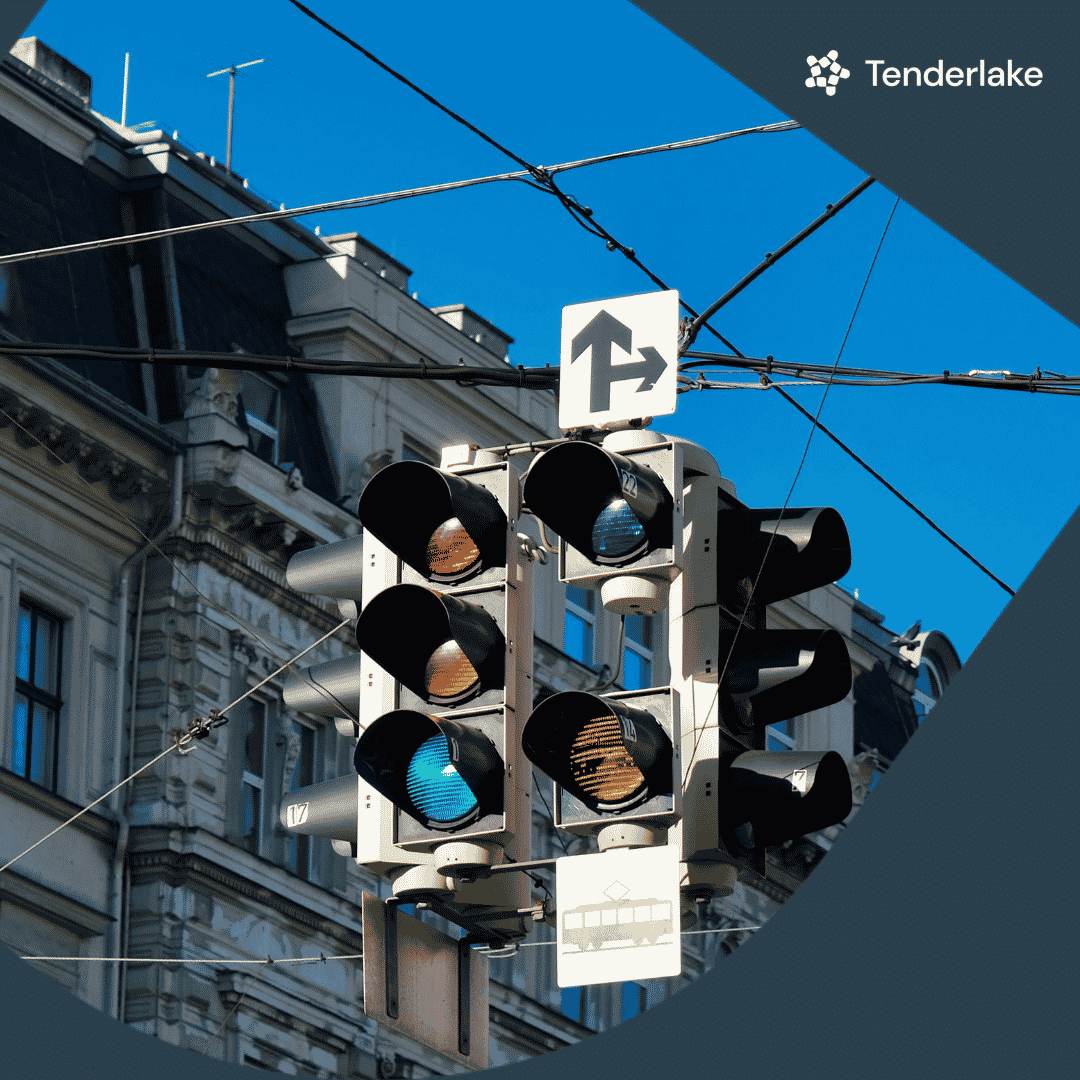
City authority launches tender for adaptive traffic signal control
A city tender aims to upgrade software on dozens of junctions so traffic lights can respond to real-time demand, mirroring a wider shift to intelligent control.
Follow Tenderlake on LinkedIn for concise insights on public-sector tenders and emerging procurement signals.
The city of České Budějovice has launched the Traffic Signal Control Upgrade contract to introduce traffic-dependent control at 41 signal controllers across the city. By focusing on software modifications and supplementary traffic control, the project aims to manage junctions in real time based on actual demand and prevailing conditions.
Published on 19th November 2026, the notice from Statutární město České Budějovice sets out a clear objective: implement software changes and add supplementary traffic control so that 41 traffic signal controllers can support demand-based management. Rather than replacing hardware outright, the city is seeking to alter how its existing controllers behave.
The description points to a shift from static timing plans towards traffic-dependent control. In practice, this kind of approach allows signal plans to be adjusted according to how much traffic is present and to local conditions at any given moment. Instead of running the same sequence regardless of whether a junction is quiet or busy, the system can prioritise movements where demand is highest and respond to changing patterns through the day.
Framing the work around software gives the buyer scope to change how junctions operate without a full rebuild of every installation. It also signals that traffic management is being treated as an ongoing operational challenge, not a one-off civil engineering project. Once controllers can respond in real time to conditions on the ground, they can be retuned as the network evolves, roadworks appear, or new transport schemes come on stream.
The České Budějovice contract sits within a dense cluster of intelligent traffic system procurements that have been emerging across European cities through 2026. Many of these combine on-street upgrades with stronger central coordination.
In June 2026, Statutární město Ostrava went to market with a Traffic Control Center Upgrade, aiming to connect traffic light signal controllers at 69 locations to a new traffic control centre. That project is designed to improve network management, provide better information to users and support transport safety through modernised and integrated telematics systems.
Also in June 2026, Statutární město Plzeň published a notice for Traffic Signal Detector Implementation, focusing on the installation of video and strategic detectors to improve vehicle detection and monitoring at signalised junctions. Where Plzeň is strengthening the “eyes and ears” of its network, České Budějovice is concentrating on the controller logic that decides how junctions respond.
Other cities have combined both strands. Statutární město Prostějov, for example, advertised an Intelligent Traffic Systems project in June 2026, seeking telematics devices, new detection cameras and an expanded city optical network for connectivity. Statutární město Brno followed in August 2026 with ITS Development in Brno, reconstructing traffic light signalling devices at two intersections and adding C-ITS technology while tying them into the central traffic control centre.
Public transport also features strongly in this wave of investment. In August 2026, Dopravní podnik města Olomouce launched a Public Transport System Modernization project to upgrade the vehicle priority system so it can communicate with modern traffic light controllers and improve the detection and prioritisation of vehicles. And in August 2026, Dopravní podnik hl. m. Prahy issued a contract notice for a new Surface Transport Control System to manage urban public transport operations with real-time functionality, high availability and strong cybersecurity.
Further afield, municipalities are pursuing similar aims through equipment renewal and integration with traffic management centres. GRAD ZAGREB, for instance, published a June 2026 notice for Traffic Signal Equipment Supply linked to its Traffic Management Center, while the municipality of Sagunto in September 2026 tendered a Traffic Control System Installation that combines 43 traffic control points, 97 smart cameras and a new management system.
Against this backdrop, the České Budějovice project stands out for its tight focus on the behaviour of the controllers themselves. While other authorities are adding detectors, cameras or new central platforms, this tender concentrates on the demand-responsive rules that will govern 41 key junctions.
A notable trend across recent notices is the way traffic control is treated as an IT system that must be maintained, secured and monitored over time. Technical content has moved beyond simple supply-and-install contracts.
In October 2026, the municipality of Amsterdam’s engineering bureau opened a market consultation on Traffic Signal Controllers Maintenance, explicitly seeking insights on refits, life-extending maintenance and new construction of controllers, while stressing operational reliability and cybersecurity. Rather than defining a fixed technical solution, Amsterdam is exploring how best to keep a controller fleet secure and dependable over a longer horizon.
Further north, Helsingin kaupunki issued a June 2026 notice for a new Traffic Light Control System that will replace an existing control and monitoring platform and connect approximately 100 control devices, with the option to add more during the contract. The emphasis there is on ongoing delivery and maintenance of a core IT system at the heart of city traffic management.
Maintenance and support frameworks are becoming common. East Dunbartonshire Council, for example, published a framework notice in October 2026 for Traffic Signal Equipment Services, covering maintenance, supply and associated works for traffic signal equipment, including fault management and civil works over at least three years. Statutární město Pardubice similarly went to tender in September 2026 for Traffic Light Maintenance Services covering the operation and upkeep of intelligent traffic light technology.
Meanwhile, road authorities are treating traffic control as part of a broader digital infrastructure. On 10th November 2026, Miasto Łódź published a contract notice for IT Infrastructure Maintenance for Traffic Control, seeking services to maintain the IT infrastructure of the Area Traffic Control System with comprehensive system knowledge and specific technical capabilities. In November 2026, Gemeente Den Haag published a notice on the Supply of Traffic Control Devices that combines procurement of traffic control devices with second-line maintenance to ensure optimal functioning for safety and flow management.
The technology mix is also expanding. On 17th November 2026, Vejdirektoratet published a tender for the Supply of Traffic Signal Control Devices, covering not only controllers but also radar detectors, cameras, thermal cameras and sound signals. In August 2026, DEPARTEMENT DE L'AVEYRON sought a Traffic Surveillance Cameras Installation project to build a monitoring platform for real-time tracking of traffic conditions, with new cameras intended to improve how information is shared with the public.
Taken together, these notices suggest a common direction of travel:
The České Budějovice upgrade, with its focus on software modifications and supplementary control, fits squarely within this pattern.
Because the České Budějovice contract centres on software modifications rather than wholesale hardware replacement, it points towards opportunities for suppliers who understand both traffic engineering and the internal logic of signal controllers. Implementing traffic-dependent control requires a grasp of how to encode priorities, manage queues and balance competing demands at complex junctions.
The project description does not spell out any link to central traffic control, but experiences elsewhere show how such upgrades can sit alongside broader network changes. Obshchina Plovdiv’s June 2026 Traffic Management System Upgrade includes both new and modified traffic light installations at 20 intersections, together with accessibility measures and author supervision during construction. In July 2026, Obshchina Ruse tendered a Traffic Light System Upgrade that combines current repairs with the implementation of an intelligent transport system for management and monitoring at intersections.
There is also a data and modelling dimension to this new generation of schemes. In August 2026, Hlavné mesto Slovenskej republiky Bratislava launched a contract for Traffic Surveys and Modeling, commissioning comprehensive surveys, a calibrated multimodal traffic model, emission and noise models, and an analysis of road network permeability. While the České Budějovice notice concentrates on controller behaviour, its focus on real-time, demand-based control sits naturally alongside such analytical work.
Other cities are integrating signal control closely with surveillance, priority systems and teletechnical infrastructure. In October 2026, Zarząd Dróg Miejskich w Warszawie tendered for Traffic Signal Monitoring and Communication, combining monitoring of installed controllers with communication for public transport priority and access to surveillance cameras. Zarząd Dróg Miasta Krakowa followed later that month with a contract for Maintenance of Traffic Control Systems, covering traffic lights and associated teletechnical infrastructure.
For transport managers, the České Budějovice upgrade offers a route to squeeze more performance out of existing junctions by changing how controllers react to what they “see” on the network. For suppliers, it reinforces the importance of being able to work across disciplines: software configuration, signal engineering, and integration with detection, monitoring and, where relevant, public transport priority systems.
The cluster of notices in November 2026 – from České Budějovice’s software-led upgrade to Den Haag’s framework for devices and maintenance, Łódź’s IT infrastructure contract and Vejdirektoratet’s multi-technology supply and maintenance tender – underlines that intelligent traffic control is now a mainstream procurement theme rather than a niche experiment.
The České Budějovice project is tightly scoped around 41 controllers and the introduction of traffic-dependent operation. The notice does not indicate whether further phases will follow, but comparable schemes in cities such as Ostrava, Prostějov, Brno and Sagunto show how incremental upgrades can build towards integrated, city-wide traffic management. How far České Budějovice chooses to travel along that path will be the key development to watch as this contract moves from procurement to delivery.
Tenderlake Monitor reads every public sector notice published across the UK, the EU and the EEA, in the language it was published in, and tells you which ones match what your company sells and why. It works from a plain description of your business, not from keywords or CPV codes.
Follow Tenderlake on LinkedIn for concise insights on public-sector tenders and emerging procurement signals.