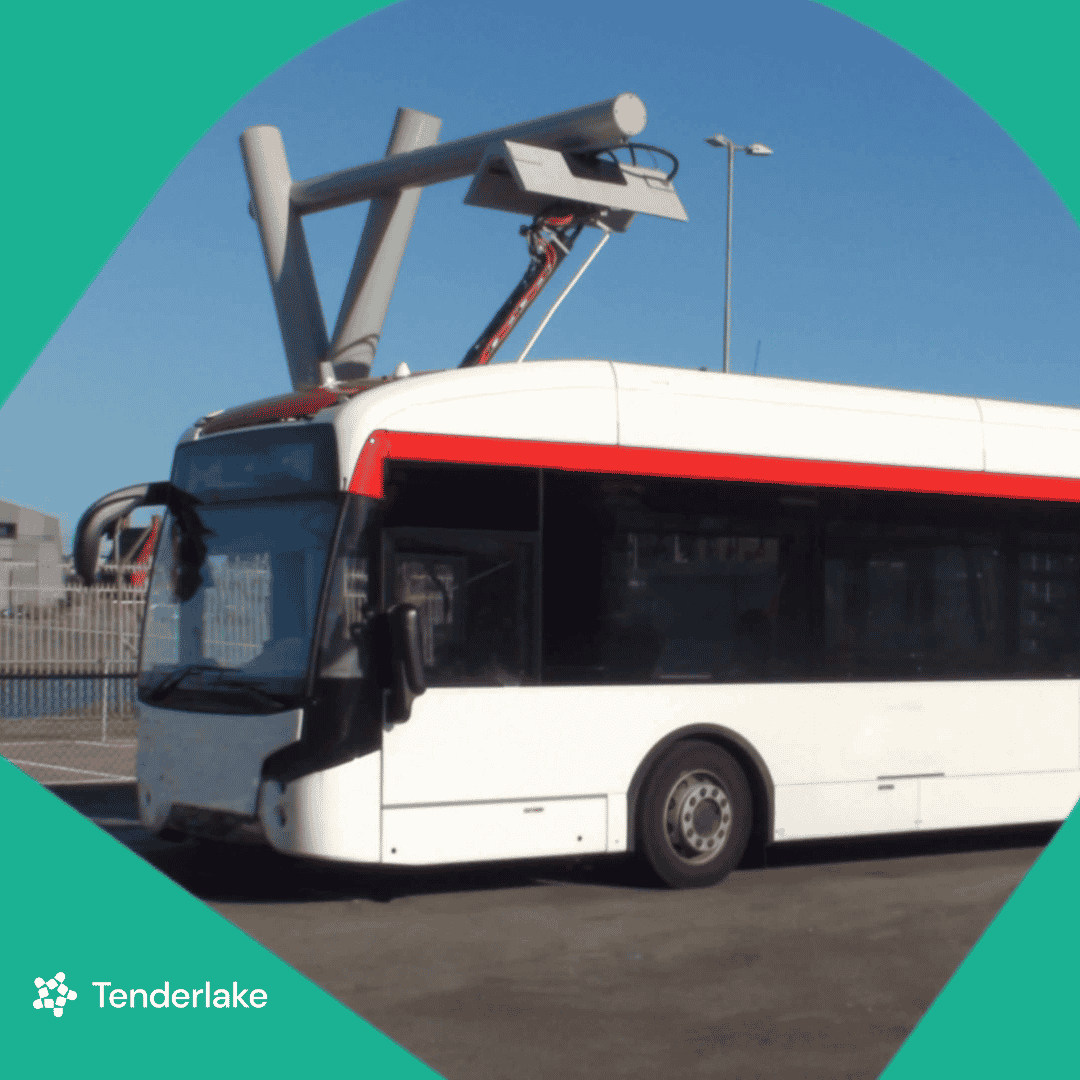
Transport operator launches tender for battery bus charging
Tender covers power supply and charging infrastructure for battery buses, reinforcing a wider shift towards depot-focused electrification projects.
Tender covers power supply and charging infrastructure for battery buses, reinforcing a wider shift towards depot-focused electrification projects.
Follow Tenderlake on LinkedIn for concise insights on public-sector tenders and emerging procurement signals.
Bus operator Kraftverkehr Bernhard Menchen GmbH & Co. KG has launched a tender for power supply and charging infrastructure dedicated to battery buses, highlighting how fleet electrification is now as much about depot energy systems as the vehicles themselves.
Published on 12th November 2026, the Power Supply for Battery Buses contract notice brings together two elements that are often procured separately: the upstream power supply and the charging infrastructure required to keep a battery bus fleet on the road.
The notice text is concise, stating only that the project involves acquiring power supply and charging infrastructure specifically designed for battery buses. This makes clear the buyer is looking for equipment engineered for bus operations, not generic passenger car charging points.
For operators, the move to battery buses turns the depot into a major energy site. Instead of refuelling with diesel, vehicles rely on electrical connections and charging systems that have to be planned, installed and maintained as a coherent system.
The available information does not spell out whether the contract covers design, installation or operation, or is limited to equipment supply. What is clear is that the buyer expects suppliers to address both the electrical feed and the charging hardware for battery buses.
Looking across recent notices, bus and depot electrification projects tend to fall into three broad strands:
By specifying both power supply and charging infrastructure in one tender, Kraftverkehr Bernhard Menchen GmbH & Co. KG is inviting bids from organisations that can work across the first two strands, rather than only delivering vehicles or components.
In June 2026, AOK - Die Gesundheitskasse für Niedersachsen issued an Electrical Work for Charging Infrastructure notice, seeking electrical work for the development of charging infrastructure. Also in June 2026, Stadt Bottrop advertised a Vehicle Charging Cables Procurement for charging cables with various specifications. Together, these show demand is not limited to complete systems; there is an active market for specialist components and installation services.
On 25th June 2026, Technische Universität Berlin went to market for a V2G Bidirectional Charging Station, covering the supply of a bidirectional DC charging station capable of vehicle-to-grid technology. That notice points towards more advanced use of charging assets, treating parked vehicles as part of the wider energy system rather than passive loads.
Bus depots are also seeing dedicated charging projects. In July 2026, Gebr. André GmbH announced a tender for the Charging Infrastructure Installation for a bus depot in Prüm, covering delivery and installation of charging infrastructure for the site. While each buyer has its own requirements, the common thread is the need to coordinate between civil works, electrical capacity and charging hardware.
Alongside infrastructure, several operators have moved ahead with battery bus procurement during 2026.
On 1st July 2026, Omnibusbetrieb Robert Lövenich GmbH & Co. KG published a notice for the Low Floor Battery Bus Procurement, covering five low floor battery solo buses. The same day, Stadtbus Tuttlingen Klink GmbH issued its own Procurement of Electric Buses. Later, on 16th July 2026, Arbeitsgemeinschaft ÖPNV Gütersloh eGbR launched a tender for Battery Electric Solo Buses for use in line traffic of class 1.
Away from heavy buses, a range of organisations are adding smaller electric vehicles to their fleets. In September 2026, Stiftung Naturschutz Schleswig-Holstein issued a notice for a Fully Electric Service Vehicle. In July 2026, IHP GmbH - Leibniz-Institut für innovative Mikroelektronik sought an Electric Transporter Procurement for passenger and cargo transport. And in September 2026, Klinikum St. Georg gGmbH advertised an E-Transporter Chassis Procurement intended for superstructure applications. Together, these notices show electric drivetrains reaching service vehicles, transporters and specialist chassis, not just frontline buses.
Electrification is also reshaping how organisations buy energy. On 7th October 2026, Ärztekammer Berlin issued a Supply of Electrical Energy contract notice for provision of electrical energy services. On 10th November 2026, Wolfsburger Verkehrs - GmbH followed with an Electricity Procurement notice for electricity services.
These contracts do not mention vehicles or depots, yet they sit alongside the charging and vehicle procurements as part of the same shift: more organisations are locking in dedicated electricity supplies to support electrified fleets and equipment.
For suppliers, the Power Supply for Battery Buses tender underlines the value of being able to offer integrated solutions that span both electrical infrastructure and charging equipment. Many of the other notices from June 2026 to November 2026 focus on single electric vehicles or discrete components; this contract places the depot energy system at the centre.
For buyers, the growing mix of contracts — vehicles, charging infrastructure, cables, electrical works and electricity supply — raises questions about procurement strategy. Key issues likely to shape future tenders include:
Details of the technical specification, contract value and delivery timetable for the Kraftverkehr Bernhard Menchen GmbH & Co. KG project are not set out in the brief notice. Even so, its focus on power supply and charging infrastructure for battery buses makes it a clear marker of how depot electrification has become a live procurement issue.
With multiple bus, vehicle and charging procurements already published between June 2026 and November 2026, the overall picture is of a market that is active and diversifying. How buyers choose to structure future contracts — whether through larger frameworks or continued stand-alone tenders — will be an important trend for suppliers and policymakers to track.
Tenderlake Monitor reads every public sector notice published across the UK, the EU and the EEA, in the language it was published in, and tells you which ones match what your company sells and why. It works from a plain description of your business, not from keywords or CPV codes.
Follow Tenderlake on LinkedIn for concise insights on public-sector tenders and emerging procurement signals.